A catalog is the coordination layer that connects data assets, metadata, storage, compute engines, and access policies. In an Apache Iceberg lakehouse, it records table identifiers, namespaces, locations, and the metadata version representing each table’s current state. Engines use it to discover tables, plan queries, and commit updates consistently across shared environments. section 7.1 section 7.1.1
A catalog typically performs four related jobs:
- Registers tables under namespaces so engines can resolve names such as analytics.marketing.sales_data to metadata locations. section 7.1.1
- Associates each table identifier with its current metadata objects, preserving versioned history for time travel and rollback. section 7.1 section 7.1.1
- Coordinates optimistic transactional commits by validating proposed metadata changes against concurrent updates and requiring retries when the commit sequence changes. section 7.1.1
- Governs metadata and storage access through IAM or SSO integration, RBAC or ABAC, credential vending, encryption, audit trails, and lineage. section 7.2.2 section 7.2.3
Catalog design separates storage, compute, and metadata coordination, enabling multiple engines such as Spark, Flink, and Trino to share table state. The tradeoff is operational: lightweight Hadoop or JDBC catalogs minimize dependencies, while self-managed REST catalogs add flexibility and advanced capabilities; managed services simplify operations but can reduce customization or portability. section 7.1 section 7.4
Choosing across environments
A simple development deployment may use a Hadoop or JDBC catalog to avoid additional services. A multi-tenant enterprise deployment may instead evaluate a REST catalog for interoperability, governance, concurrency, operational overhead, cloud strategy, and cost. A cross-region recovery design must replicate catalog state alongside data and metadata, then address absolute file paths when reconstructing tables. section 7.4 section 7.5 section 11.3.3
Figure 7.2 An Apache Iceberg catalog maps each table name to the location of its latest metadata file, which serves as the entry point for tools to begin scanning and interacting with the table.
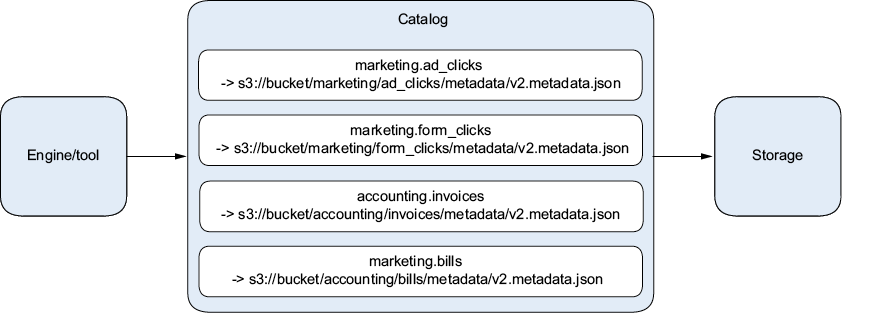
Shows how a table name maps to the latest metadata file, the entry point engines use to scan and update the table. section 7.1
Table 7.1 A comparison of Apache Iceberg catalogs
| Name |
OSS |
REST catalog |
Features |
|---|---|---|---|
| Hadoop |
Yes |
No |
No service required; potential consistency issues |
| JDBC |
Yes |
No |
Can use any JDBC database as a catalog |
| Hive |
Yes |
No |
Leverage existing Hive catalog |
| Apache Polaris |
Yes |
Yes |
RBAC; catalog federation; multi-tenancy |
| Project Nessie |
Yes |
Yes |
Git-like catalog versioning |
| Apache Gravitino |
Yes |
Yes |
Federation with Hive; geodistributed catalog |
| Lakekeeper |
Yes |
Yes |
Rust-based; supports data contracts |
| AWS Glue Data Catalog |
No |
Yes |
Integrated in AWS tooling |
| Dremio catalog |
Polaris-based |
Yes |
Commercial service built on Apache Polaris with automated table maintenance; charges based on compute used for maintenance; external requests not charged |
| Snowflake Open Catalog |
Polaris-based |
Yes |
Commercial service built on Polaris; charges on requests to the catalog |
| Databricks Unity |
No (OSS version different codebase) |
Yes |
Supports Iceberg and Delta Lake |
Compares Iceberg catalog implementations by service model, REST support, governance features, and operational tradeoffs. section 7.4
