A categorical palette assigns distinct colors to nominal categories, where the colors identify groups without suggesting magnitude or order. Choose categorical colors for nominal values; use sequential or diverging palettes for ordered values. section 3.1.2
Build the palette around the chart’s purpose and visual mood. A custom visualization uses eight colors for painting subjects plus another color for letters and drawings, with related hues distinguishing similar categories. section 14.3
Keep categorical palettes usable and accessible:
- Do not make color the only carrier of category information; add patterns or varied shapes for people with color blindness. section 10.3
- Check contrast for chart geometries, large text, and regular text against the background. section 10.3
- Expect many categories to require similar hues, so reinforce distinctions with non-color encodings. section 10.3 section 14.3
Figure 14.7 For this project, we’ll need a categorical palette of eight colors for the painting subjects and an additional color for the letters and drawings. By playing with the brightness, we generate two other variations of this last color that we’ll use for the text and the project’s background.
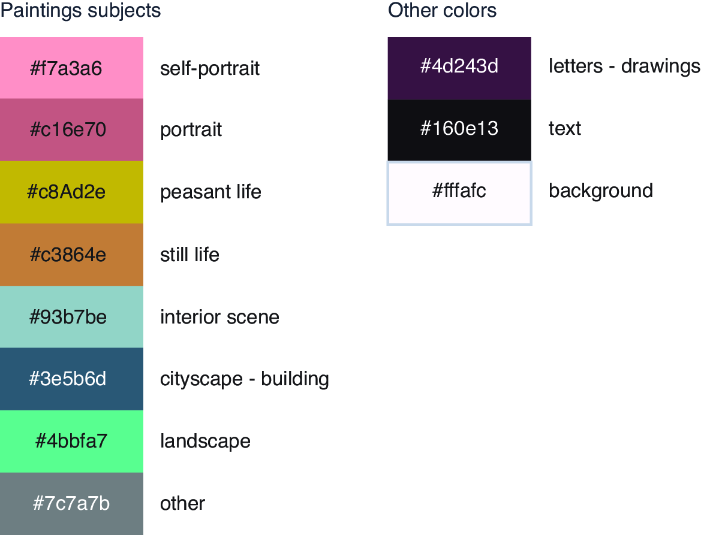
Compare the eight category colors with the additional color and its brightness variations for letters, text, and the background. section 14.3

