Causal abstraction creates high-level variables from lower-level data while preserving causal assumptions about the data-generating process. It chooses variables at the level where meaningful causal questions can be asked. section 3.1.1
Raw data may be too detailed for a causal model. A pixel-level DAG for an image is unwieldy and rarely answers useful questions such as the causal effect of one pixel on another. section 5.1.2
Build a causal abstraction by:
- Identifying the high-level variables required by the causal question. section 3.1.1 section 5.1.2
- Mapping low-level observations to those variables through domain knowledge or analytical methods such as mathematics and logic. section 3.1.1
- Checking that the mapping preserves assumptions about the underlying data-generating process. section 3.1.1
From pixels to causal variables
A medical-imaging dataset may contain pixel matrices while the causal model uses a binary Tumor variable. In image datasets such as MNIST and TMNIST, a compact causal model is more useful than treating all 784 pixels as separate causal nodes. A learned representation Z is not automatically a good causal abstraction: reconstruction-focused autoencoders preserve information broadly, whereas causal representations should retain causal information and ignore non-causal information. section 3.1.1 section 5.1.2 section 5.2.5
Figure 5.7 A plate model representation of the causal DAG. Plates represent repeating variables, in this case 28 × 28 = 784 pixels. Xj is the jth pixel.
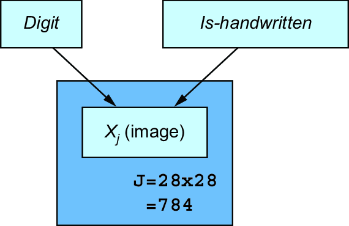
Use the plate model to inspect how 784 repeating pixel variables can be represented without making the causal model operate at an impractical pixel-by-pixel level. section 5.1.2
