Suppose a model encodes a video of a child holding a helium balloon. If removing the child from the representation and generating a new video makes the balloon rise, the representation has captured something causally meaningful. A geometric description of the original frames alone need not support that change. Causal representation learning seeks features that retain causal relationships, rather than merely enough information to reproduce the input. section 1.4.1 section 5.2.5
The first modeling choice is the level of abstraction. Data may contain pixels, while the causal question concerns a tumor’s presence or the objects depicted in an image. Turning low-level observations into high-level variables is causal abstraction: the mapping must preserve assumptions about how the data was generated. Domain knowledge, labels, or analytical mappings can supply those variables before they become nodes in a causal DAG. section 3.1.1 section 13.2.3
Two checks distinguish a useful encoding from a causal one:
- Does it retain the relevant causes rather than every detail? An image encoder optimized for reconstruction tries to preserve input information; its latent variable Z need not separate causal from non-causal factors. Disentangling those factors is generally impossible without labels for Z, though domain knowledge, interventions, and semi-supervision can help. section 5.2.5
- Does its structure support the causal question? In a variational-autoencoder-based causal generative model, a decoder can map parent labels to an image, while an encoder maps the image and labels to Z. Z may stand in for unmodeled causes without becoming an ideal causal representation. section 5.4
Causal structure in generated stories
A script generator can treat events in a three-act story as causally connected: earlier acts affect later ones. One proof-of-concept uses 21,000 sets of short vignettes organized around such event roles. Making that structure explicit during training is a way to seek better causal representations; modeling the probabilities of act-level archetypes alone would not yet generate scripts. section 13.3.1
Figure 13.2 X1 through X12 are a sequence of tokens. Whatever structure (causal or otherwise) exists between the tokens is of passing interest. We are interested in the causal relations between concepts described by the tokens.
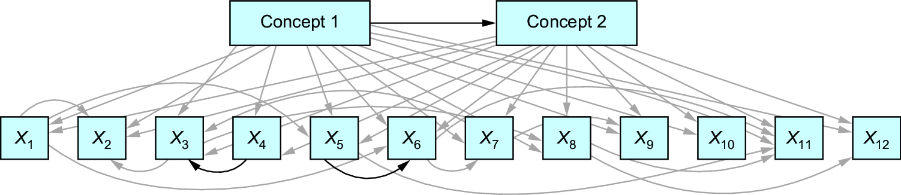
Use the token-sequence diagram to locate the abstraction problem in language: relationships between individual tokens are not the same as causal relationships between the concepts they describe. Attention may learn higher-level representations, but that alone does not establish that they are causal or easy to verify. section 13.2.3 section 13.4
When a learned representation cannot be trusted to carry causal structure on its own, an explicit DAG can provide the scaffold. Fine-tuned language models composed over that scaffold can admit causal operations such as a do-operator. The practical aim is not simply better prediction or reconstruction, but a model whose abstractions match the interventions and counterfactuals the application needs. section 13.4 section 1.4.1
