When a model predicts purchases from ad features, it may fit correlations without explaining what drives the outcome. A causal structure organizes variables and directed relationships so the model follows a domain process: ad impressions drive engagement, which drives purchases. section 1.3.3
Representing the structure explicitly supports practical modeling decisions:
- Decompose a model into domain-aligned components, such as {ad impression, engagement} and {engagement, purchase}. section 1.3.3
- Test, validate, execute, retrain, and reuse components independently. section 1.3.3
- Encode causal relationships in a directed acyclic graph or causal generative model rather than relying only on a predictive feature network. section 13.3.1 section 1.3.3
Three-act narrative generation
A narrative structure can specify that act 1 causes act 2, and acts 1 and 2 cause act 3. A King–Prince–Kingdom archetype enumerates possible actions and outcomes, yielding 3 × 3 × 3 = 27 archetypes. Causal Markov kernels in pgmpy or Pyro can represent the archetypes before generating scripts from the causal model. section 13.3.1
Figure 1.2 A model that captures how ad impressions drive engagement, which in turn drives purchases. This model decomposes into {ad impression, engagement} and {engagement, purchase}.
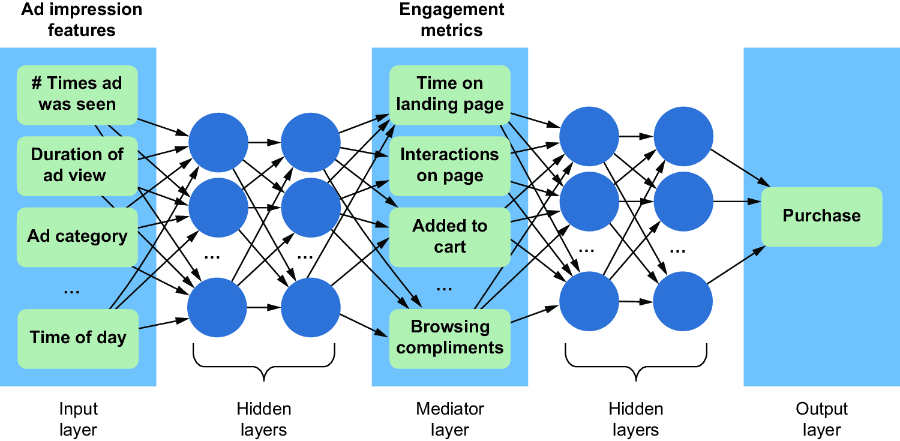
Use the causal funnel diagram to inspect how the model decomposes into linked, interpretable components. section 1.3.3
