Suppose a digit recognizer is trained on handwriting from one group of writers and used on another. It may learn patterns that depend on the training group rather than how writers produce digit images. A causal mechanism describes how causes generate an effect. Reasoning about those processes can help a model remain useful when the distribution of writers changes. section 1.5.2
A causal directed acyclic graph (DAG) identifies what causes what, but not how a cause affects its result. Age and gender may both cause education outcomes, for example, without the graph showing how their effects interact. Different logic gates can likewise share the same DAG while producing different outputs from the same inputs. The graph is a statement of causal assumptions, not a complete description of the mechanism. section 3.1.3
Figure 3.4 The various kinds of logic gates all have the same causal DAG.
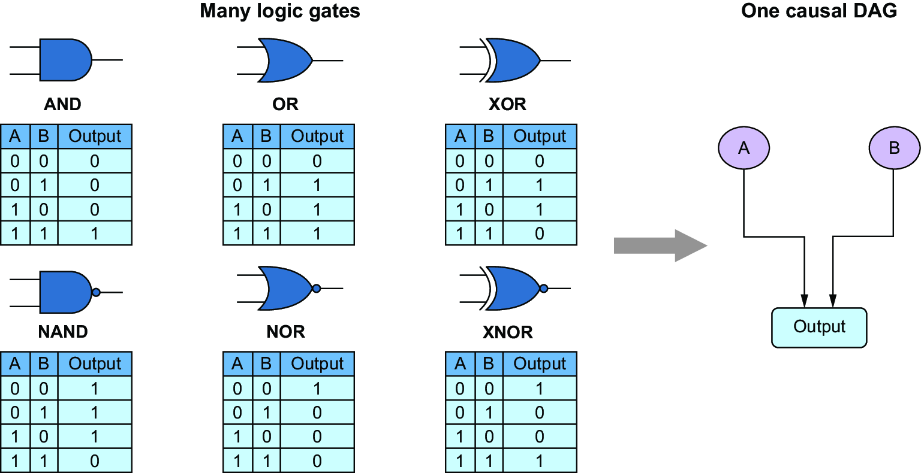
Compare the gates’ outputs: identical causal arrows do not imply identical rules for generating an effect. section 3.1.3
A causal graphical model can attach a conditional probability distribution, or causal Markov kernel, to a variable and its parents. For example, P(R | E) models residence given education. If the mechanism generating residence from education changes, this kernel may change while a distinct kernel, such as P(T | O, R) for transportation given occupation and residence, retains its parameters. This separation is an assumption about the system, not a guarantee supplied by the graph. section 3.2.3
Make the mechanism explicit
In a forensic height model, let x be femur length in centimeters and y be height in centimeters: y = 25 + 3x + nᵧ, with nᵧ ~ N(0, 3.3). The noise term represents variation from other causal factors. As a structural causal model, the equation asserts a linear mechanism: a change in femur length produces a proportional change in height. Linearity is a causal assumption here, not merely a convenient fitting choice. section 6.1.1
When an equation is difficult to specify, a plain-language account can still propose a mechanism. Higher ad spending might increase brand awareness through wider and more frequent exposure, with diminishing returns from saturation or ad fatigue. Such an explanation goes beyond the arrows in a DAG, but it should not be mistaken for an established functional relationship or an assumption-free counterfactual result. section 13.1.3
