A centralized control plane concentrates some or all control-plane functions in a controller. Unlike a distributed control plane, where each router runs protocols such as OSPF and independently calculates routes, the controller maintains a global network view, applies routing logic, and distributes forwarding instructions. Network devices continue performing data-plane forwarding. section 22.2.2 section 22.4
Figure 22.5 SDN architecture centralizes the Control Plane functions in the controller. However, the Data Plane functions (message forwarding) remain distributed among each network device.
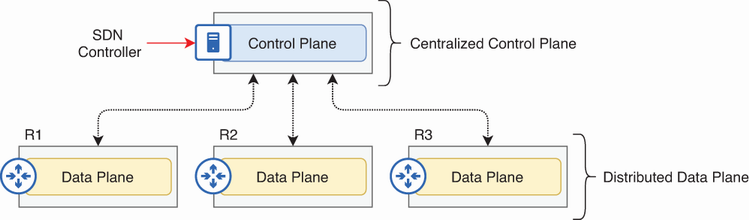
Shows how SDN centralizes control-plane functions while leaving message forwarding distributed across network devices. section 22.2.2
The SDN architecture separates responsibilities into three layers:
- Application Layer communicates network requirements and desired behaviors to the controller. section 22.2.2
- Control Layer translates high-level requirements into actionable instructions for network devices. section 22.4
- Infrastructure Layer contains routers and switches that execute controller instructions. section 22.4
Figure 22.6 The three layers of SDN architecture: Application, Control, and Infrastructure. The NBI facilitates communication between the Application and Control Layers, and the SBI facilitates communications between the Control and Infrastructure Layers.
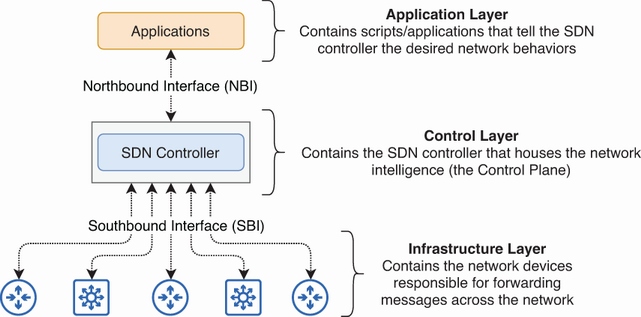
Maps the Application, Control, and Infrastructure Layers, including their northbound and southbound interfaces. section 22.2.2 section 22.4
Applications communicate with the controller through a northbound interface, typically using REST APIs and HTTP. The controller communicates with infrastructure through a southbound interface that can use OpenFlow, NETCONF, OpFlex, SSH, or SNMP. This model enables programmatic network control without moving message forwarding into the controller. section 22.4
