Centralized decision-making concentrates authority in a central person or group. It can create alignment, but prolonged focus may produce delays and motivate a swing toward decentralization. section 10.3.1
Team A and Team B
Team A depended on Team B to configure missing attributes through Jira requests. Team A proposed an event-driven message instead, but Team B lacked messaging infrastructure and other priorities caused further alignment delays. The later move toward decentralization also left teams waiting on one another, revealing a polarity rather than a problem solved by choosing one side. section 10.3.1
Use the pattern as a polarity to examine rather than treating either extreme as a complete solution:
- Identify the costs of concentrated authority before pursuing greater team autonomy. section 10.3.1
- Watch for the opposite costs after decentralizing, including teams waiting on one another. section 10.3.1
Figure 10.8 A shared kernel pattern. Four teams each own their own bounded context, but they share a model. Every time that model is affected, they need to talk to the other teams to change it.
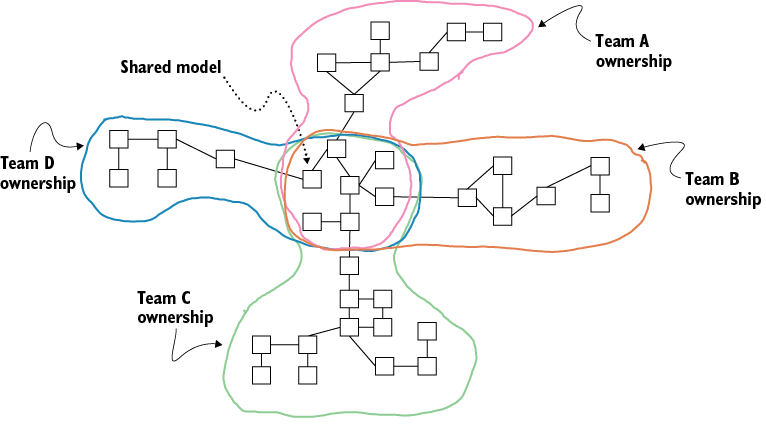
A shared-kernel diagram makes the coordination dependency visible: multiple teams own bounded contexts but must communicate when the shared model changes. section 10.3.1
