A certainty equivalent value is the guaranteed amount that provides the same utility as a specified risky prospect. It translates an abstract utility difference into dollars, making risk-adjusted financial choices easier to compare. section 6.3.1 section 6.4
The result depends on the utility function and its curvature. Concave utility represents risk aversion: as wealth rises, each additional dollar contributes less utility. The CRRA power utility function uses η to represent relative risk aversion; η = 0 is risk-neutral, while larger η indicates greater risk aversion. section 6.3.1
A coin-flip prize
Consider a coin flip paying $10 million for a correct guess and nothing otherwise. With the utility function illustrated for the example, the certainty equivalent is $2.5 million: the person is indifferent between that guaranteed amount and the risky prize. section 6.3.1
Delaying Social Security
For a 62-year-old choosing between claiming Social Security at 62 or waiting until 70, increase starting wealth under the earlier-claiming strategy until its utility matches the later-claiming strategy. With CRRA η = 3, the equivalent amount is $35,000, exceeding a year of Social Security payments. section 6.4
Figure 6.6 Certainty equivalent value of a coin flip
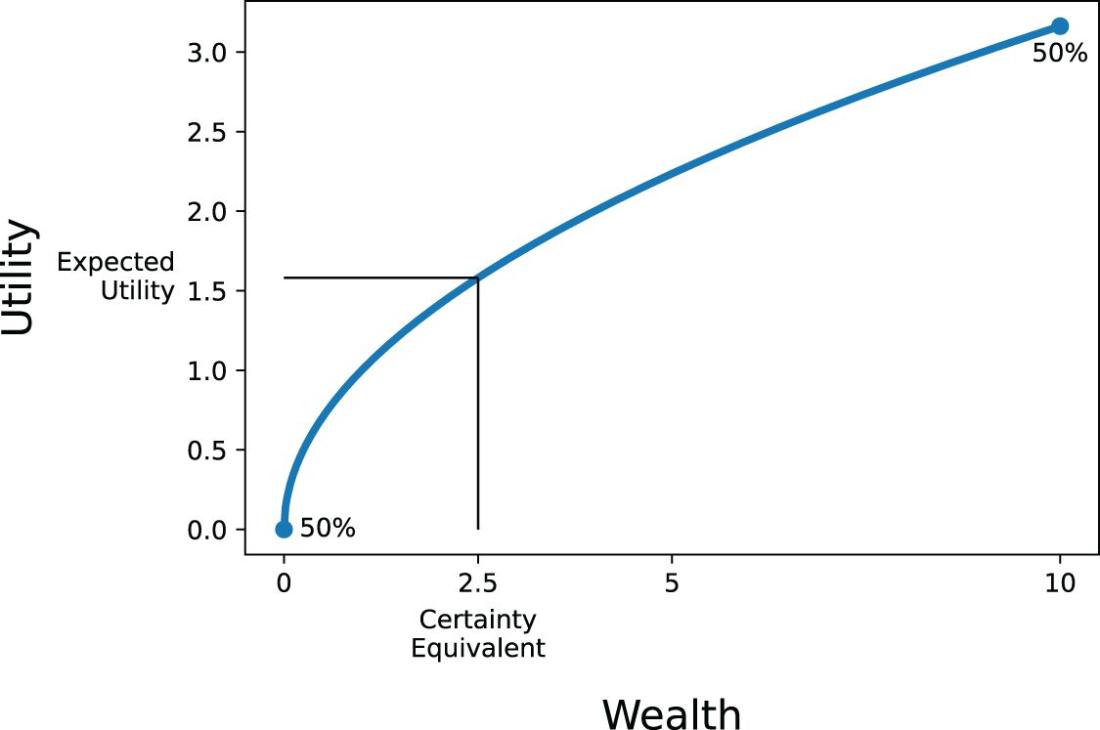
Visualizes the certainty equivalent of the coin-flip prospect. section 6.3.1
Figure 6.7 Quantifying the benefit of claiming Social Security at 70 vs. 62
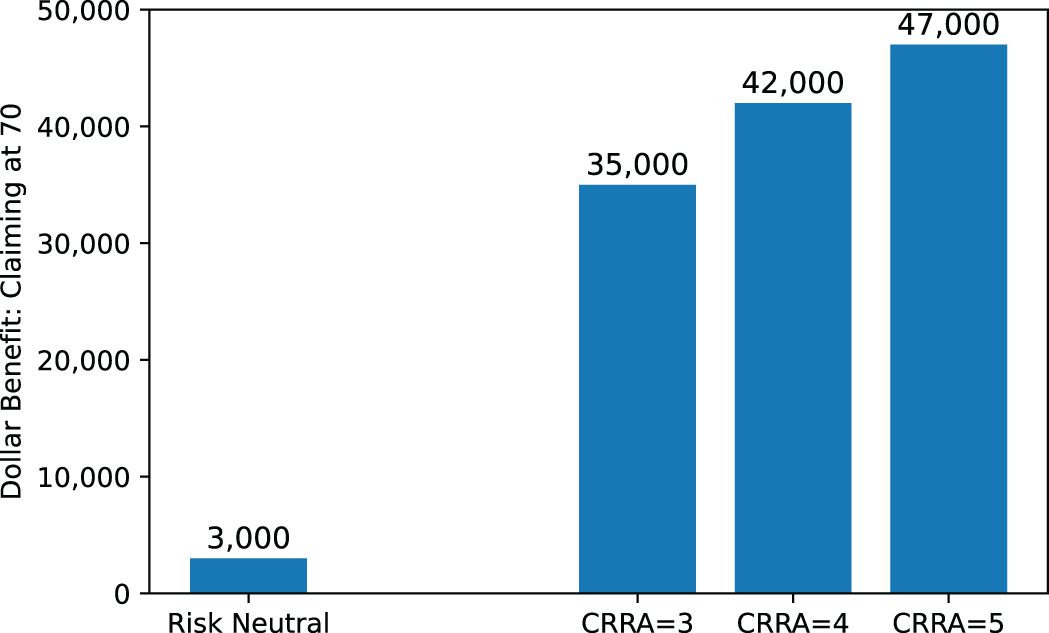
Visualizes how risk aversion changes the dollar value of delaying Social Security. section 6.4
