A utility function assigns value to an outcome according to how useful it is for an optimization goal. In Bayesian optimization, utility measures whether a query helps find a better objective value, rather than rewarding its raw value alone. section 4.2.1
Improvement over the best-seen point
Suppose one evaluation returns 2 and another returns 10. The second is better until a previous observation has already achieved 20; then neither adds useful improvement. An observation returning 21 does add utility because it exceeds the incumbent, the best value found so far. section 4.2.1
Utility can encode different priorities when selecting the next query:
- Improvement-based utility values a point according to how much it may exceed the incumbent, using the Gaussian-process belief about the objective. section 4.2.1
- Cost-aware utility values information gained per unit of query cost, following a return-on-investment calculation. section 9.3.2
- The cost-aware trade-off can favor inexpensive low-fidelity queries, but high-fidelity queries become preferable when low-fidelity data or prices make them more valuable. section 9.3.2
Figure 9.10 The formula of the ROI acquisition score for multifidelity optimization. This score quantifies the amount of information a query provides about the objective’s optimum for each unit of cost.
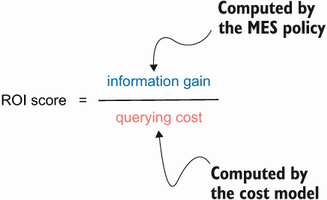
Use the ROI acquisition-score formula to see how information gain is divided by query cost in multifidelity optimization. section 9.3.2
