A certificate chain lets a browser connect a website’s identity to a root certificate it already trusts. It is sent by the server during the TLS handshake. section 9.2.1
Read the chain from the website outward:
- Leaf certificate: identifies the domain, such as google.com, and contains the website’s long-term public key. section 9.2.1
- Intermediate CA certificates: connect the leaf certificate to a root CA through signatures. section 9.2.1
- Root certificate: ends the chain and is trusted because it is stored in the browser’s trust store. section 9.2.1
Following Google’s chain
A browser can validate a Google certificate for *.google.com through the intermediate GTS CA 101, whose certificate is signed by the trusted GlobalSign root CA. section 9.2.1
Figure 9.6 The authentication part of a handshake starts with the server sending a certificate chain to the client. The certificate chain starts with the leaf certificate (the certificate containing the website’s public key and additional metadata like the domain name) and ends with a root certificate that is trusted by the browser. Each certificate contains a signature from the certificate above it in the chain.
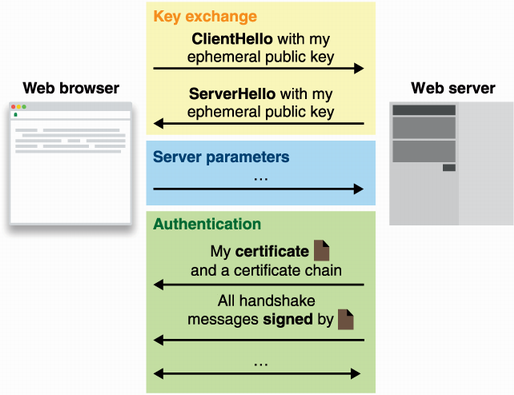
Trace the leaf-to-root order and see how each certificate is signed by the certificate above it. section 9.2.1


