Certified EHR technology (CEHRT) is electronic health record technology whose vendor product meets the standards and certification criteria established through the ONC Health IT Certification Program. Certification created a shared baseline for EHR capabilities across otherwise highly varied products, implementations, clinical settings, and proprietary architectures. It made an EHR more than a local digital chart: a production system expected to support the capture, coordination, and use of health data in clinical work. section 1.2.6 section 2.2
CEHRT emerged alongside HITECH and the Medicare and Medicaid EHR Incentive Programs, commonly called Meaningful Use. Vendors certified their products against the applicable criteria; hospitals and clinicians could use certified systems when attesting that they had met Meaningful Use requirements. The arrangement connected federal adoption incentives to concrete product capabilities rather than treating digitization as merely purchasing any electronic record system. section 1.2.6 section 2.2.1
The early certification-and-adoption model established a practical baseline for EHR use:
- Use the EHR as the principal tool for ordering, documenting, and exchanging health data. section 2.2.1
- Capture key clinical information as structured data, including problem lists, medication lists, allergies, vital signs, and patient demographics. section 2.2.1
- Support Computerized Provider Order Entry (CPOE) for medication orders. section 2.2.1
- Coordinate tasks, responsibilities, states, and recorded data across clinical workflow participants. section 2.2
Lab ordering as a certified-workflow context
In a CBC workflow, the clinician, nurse or phlebotomist, and laboratory advance work through the EHR. The system moves the order through states, directs tasks to the appropriate people and systems, and records resulting data. Certification does not erase vendor-specific screens, configuration, or data models, but the shared baseline helps explain why different EHRs perform this core workflow-coordination role. section 2.2 section 2.2.1
Certification was an important step toward interoperability, but it did not end the problem of moving data between organizations. Once structured health data existed in EHRs, the next challenge became exchanging it with the right people at the right time. Later Cures Act rules extended the operational expectation for certified health IT by prohibiting information blocking and requiring standardized APIs for interoperable exchange without special effort. section 2.2.1 section 1.2.6
Figure 1.4 The progression of U.S. health IT policy: Trust baseline → Digitization incentives → Interoperability mandates.
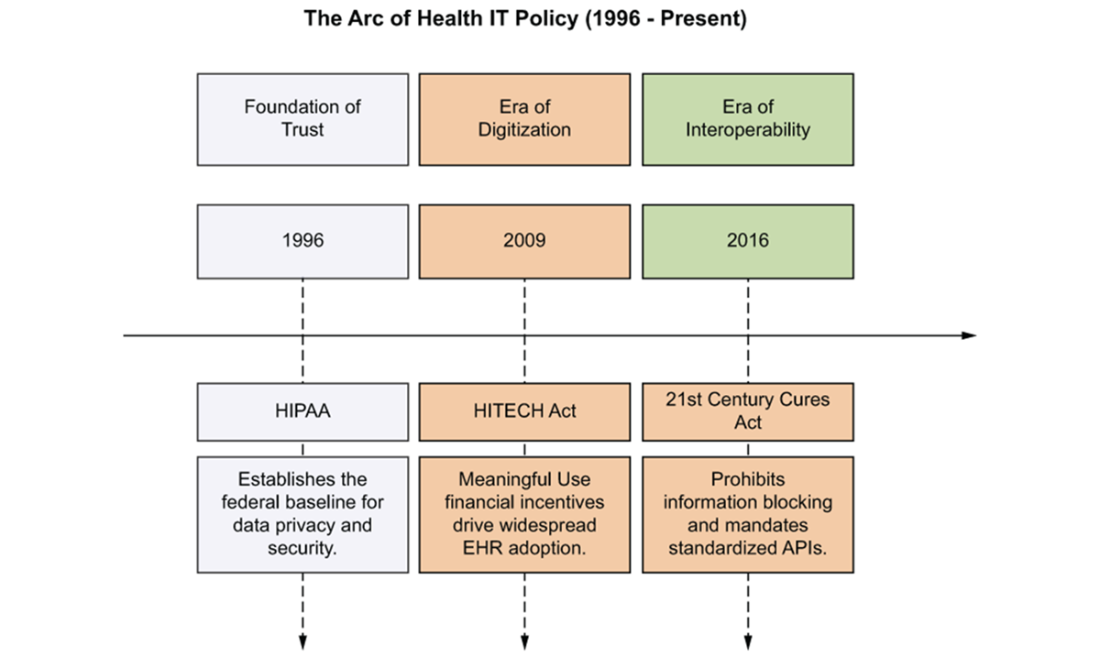
Trace the policy progression from a trust baseline through digitization incentives to interoperability mandates; CEHRT sits at the point where adoption policy became product capability requirements. section 1.2.6