The HITECH Act marked a policy shift from paper-based, siloed healthcare toward electronic health records and interoperable health information. For developers, it establishes why contemporary health IT must be understood through regulatory context, patient access, and API requirements. section 1.2.6 section 1.3
HITECH's practical significance appears in several connected changes:
- Accelerated healthcare digitization while much clinical information remained paper-based and confined to siloes. section 1.3
- Raised expectations from initial EHR adoption toward practical, developer-ready APIs and better patient and clinician access. section 1.3
- Placed health IT development within an evolving framework where compliance, interoperability, precision, and trust affect system design. section 1.2.6 section 1.5
From adoption to exchange
Reported office-based physician EHR use rose from 48.3% using a partial EHR system in 2009 to 88.2% using any EHR system in 2021. The resulting developer challenge is no longer digitization alone, but reliable exchange across systems and organizations. section 1.3 section 1.5
Figure 1.4 The progression of U.S. health IT policy: Trust baseline → Digitization incentives → Interoperability mandates.
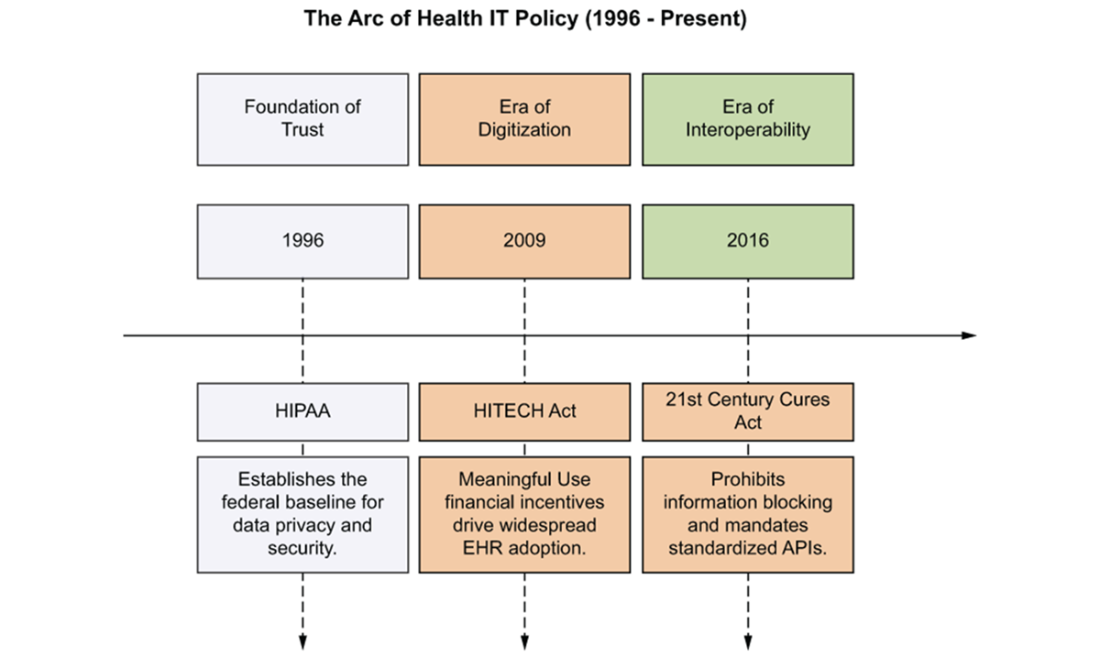
Use the policy progression to place HITECH between HIPAA's trust baseline and later interoperability mandates. section 1.2.6