Meaningful Use was the Medicare and Medicaid EHR Incentive Programs implemented by CMS in July 2010 under HITECH. It used financial incentives to accelerate EHR adoption, requiring hospitals and providers to demonstrate specified use of EHR systems. The ONC Health IT Certification Program supplied the certification criteria for Certified EHR Technology (CEHRT), enabling organizations to attest that their adopted systems met program requirements. section 1.2.6
The program was phased into sequential stages with objectives, deadlines, incentives, and reportable thresholds. For developers, the requirement was not merely to add compliance features: those features had to work inside everyday clinical workflows so an organization could attest successfully and receive payment. Meaningful Use therefore established a technical baseline for later EHR products, even after its original incentive programs ended. section 2.2.1
Stage 1 organized attestation around organization type and objective category:
- Eligible Professionals had to meet all 15 core objectives and 5 of 10 menu objectives, including one public-health objective. section 2.2.1
- Eligible Hospitals and Critical Access Hospitals had to meet all 14 core objectives and 5 of 10 menu objectives, including one public-health objective. section 2.2.1
- Core and menu objectives turned EHR use into measurable obligations rather than a general commitment to digitization. section 2.2.1
Meaningful Use created different implementation paths. Organizations pursuing strategic modernization redesigned workflows, trained staff, and built governance so capabilities such as computerized provider order entry, electronic data capture, and patient portals became routine operations. Others pursued minimal viable compliance: enough functionality to operate and attest. This distinction matters because an EHR's practical shape reflects implementation strategy as well as software code. section 2.3
In 2018, Meaningful Use was formally rebranded as the CMS Promoting Interoperability programs, with updated measures and scoring focused on interoperability and patient access. The original HITECH-era Stage 1 and 2 incentive programs were effectively sunset in 2021, and payments are no longer disbursed. Its legacy remains consequential: incentive-driven deadlines helped drive EHR adoption, while rushed workflow design and documentation demands were associated with clinician burnout, vendor lock-in, and weak patient-centered design. section 2.2.1 section 2.3
Figure 1.4 The progression of U.S. health IT policy: Trust baseline → Digitization incentives → Interoperability mandates.
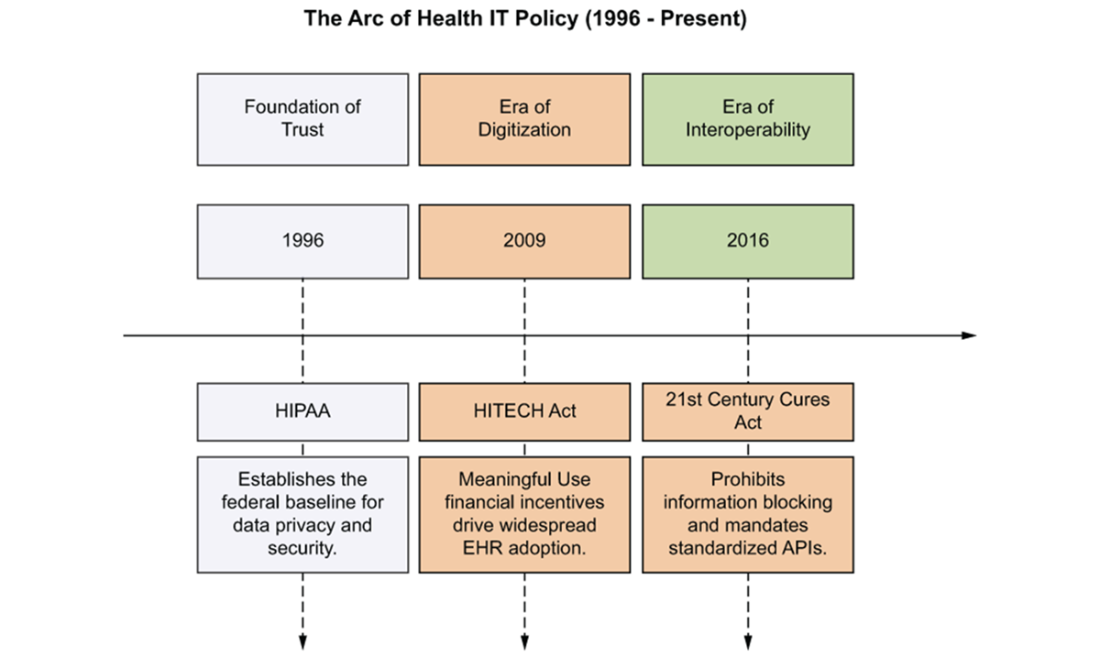
Places Meaningful Use between early health-data trust foundations and later interoperability mandates, clarifying its role as a digitization incentive. section 1.2.6
Figure 2.7 The spectrum of EHR implementation strategies based on organizational incentives.
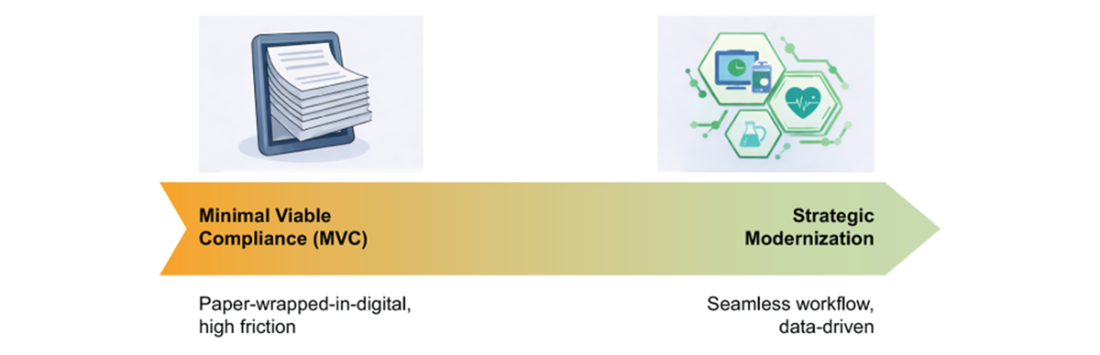
Shows the implementation spectrum from minimal viable compliance to strategic modernization, where the same incentive program can produce different operational outcomes. section 2.3