A workflow manager executes and coordinates ordered computational tasks by representing them as a directed acyclic graph (DAG). It invokes scripts on target machines, manages dependencies between steps, and abstracts the complexity of chaining pipeline operations. section 4.3.3
A workflow manager helps teams:
- Specify a pipeline without writing a control loop for every task. section 4.3.3
- Run scripts that load, join, transform, or clean data across stores and virtual machines. section 4.3.3
- Delegate execution and scheduling across complex data resources and technical stacks. section 4.3.3
ELT pipeline
One DAG loads Table X from System A and Table Y from System B, joins them, and removes null values. Each step can contain internal steps or invoke another workflow independently. section 4.3.3
Figure 4.1 An example DAG: it’s directed (D) as the information flows one way along the arrows. It’s acyclic (A) because there aren’t any cycles, and it’s a graph (G) because that’s what this sort of thing is called.
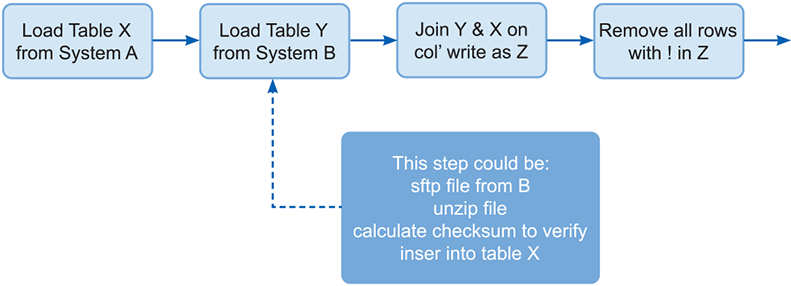
Use the DAG figure to trace one-way task dependencies and distinguish directed, acyclic, and graph structure. section 4.3.3
