Computerized provider order entry (CPOE) makes the EHR the working point for authorized providers to enter medical orders rather than relying on paper-based processes. It turns the EHR from a passive data repository into a tool for ordering, documenting, and exchanging clinical information. section 2.2.1
Meaningful Use established CPOE as a measurable part of EHR adoption and later expanded its operational scope:
- Stage 1 required CPOE for medication orders and structured capture of problems, medications, allergies, vital signs, and demographics. section 2.2.1
- Stage 2 raised the medication-order threshold from 30% to 60% and added laboratory and radiology order thresholds. section 2.2.2
- CPOE therefore participates in a broader shift from local electronic capture toward exchange across systems, organizations, and patients. section 2.2.2
Implementation strategy matters
A hospital may redesign workflows, train clinicians, and establish governance so CPOE becomes part of daily care, or it may implement only the minimum functionality needed for compliance. The latter approach can leave rushed workflows, documentation burden, clinician burnout, vendor lock-in, and weak patient-centered design. section 2.3
Figure 2.4 The policy progression from internal data capture to networked data movement.
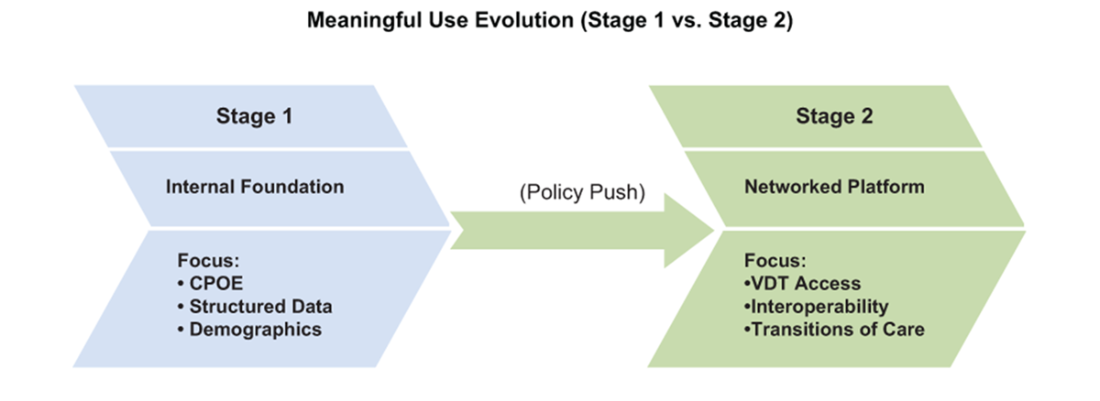
Trace the policy progression from internal EHR data capture to networked movement of clinical data. section 2.2.2
Figure 2.7 The spectrum of EHR implementation strategies based on organizational incentives.
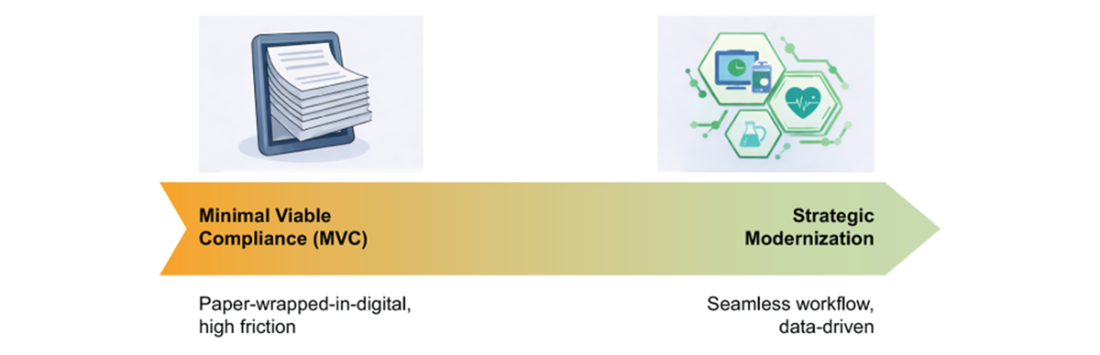
Compare implementation strategies ranging from minimal viable compliance to strategic modernization. section 2.3