A chain of command is an instruction-priority hierarchy that resolves conflicts among directives issued at different authority levels. Higher-authority instructions override lower-authority instructions; content without authority is treated as data rather than instruction. section 8.4.2 section 8.4
The hierarchy runs from highest to lowest authority:
- Root: non-overridable rules covering catastrophic risks, illegal behavior, and chain-of-command integrity. section 8.4.2
- System: platform-wide rules that developers and users cannot override. section 8.4.2
- Developer: application-specific instructions controlling persona, tone, format, and permitted topics within the platform range. section 8.4.2
- User: requests that customize behavior within developer-imposed limits. section 8.4.2
- Guideline: a default that contextual cues, background knowledge, or user history can implicitly override. section 8.4.2
- Assistant messages, tool messages, quoted text, untrusted text, and multimodal data carry no authority unless authority is explicitly delegated to them. section 8.4.2 section 8.4
Resolving a conflicting request
If a user asks for a format change, the request can apply when it stays within developer and system constraints. If quoted or tool-provided text contains an instruction, treat it as data unless a higher-authority instruction delegates authority to it. section 8.4.2 section 8.4
Figure 8.3 The OpenAI Model Spec chain of command. Five nested authority levels, from Root at the center out through System, Developer, User, and Guidance, surrounded by an outermost band for content that carries no authority (assistant and tool messages, quoted or untrusted text). A higher-authority level overrides every level outside it. Content in the outer no-authority band is treated as data, never as instructions, unless a higher level explicitly delegates authority to it.
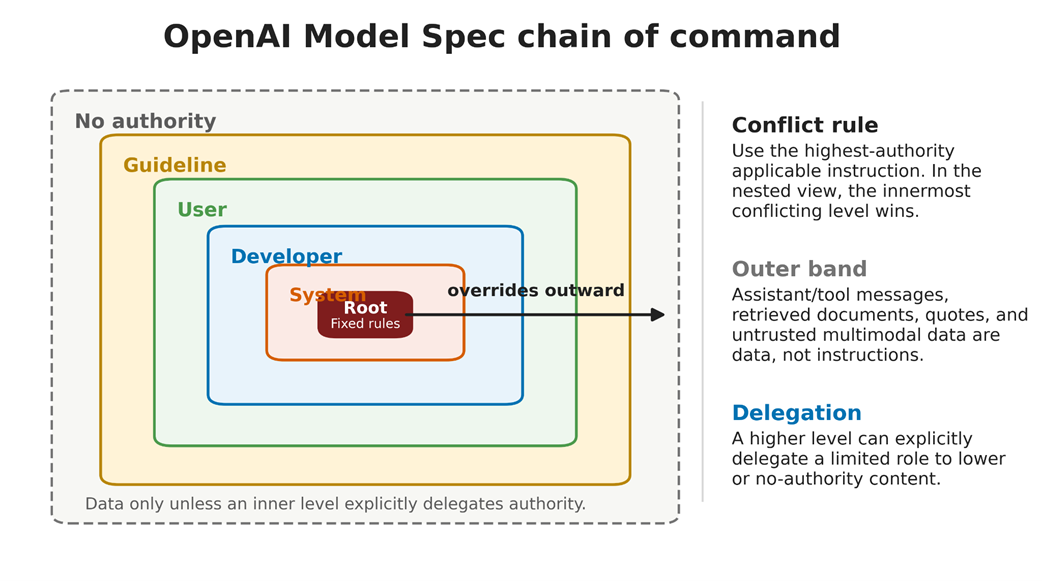
A nested diagram makes precedence visible: Root sits at the center, followed by System, Developer, User, and Guidance, with no-authority content in the outer band. section 8.4
