Chain-of-thought (CoT) prompting gives a model intermediate reasoning steps to follow on a multistep task. Rather than showing only a question and answer, a prompt demonstrates how to reach the answer. The resulting steps can make the model’s logic easier to inspect—a useful first line of defense when a confidently wrong answer would be costly. section 2.7.3 section 1.4.1
Two practical forms are:
- Few-shot CoT: include a worked example with intermediate steps and a final answer, then present a new problem in the same format. Even one demonstration can establish the pattern. section 2.7.3
- Zero-shot CoT: add an instruction such as “Let’s think step by step” without supplying a worked example. More directed wording can ask the model to identify key elements first, then explain its reasoning. section 2.7.3 section 2.7.4
Check the arithmetic, not just the answer
For “4, 8, 9, 15, 12, 2, 1,” a worked answer identifies the odd numbers, adds 9 + 15 + 1 = 25, and concludes that their sum is not even. The same pattern can then be applied to a new list. In customer support, a prompt can similarly state the rule—an order number ending in an odd digit qualifies for a discount—before checking that Order #17403 ends in 3. section 2.7.3 section 2.7.4
Figure 2.1 Few-shot, few-shot CoT, zero-shot, and zero-shot CoT prompting compared (Kojima et al.)
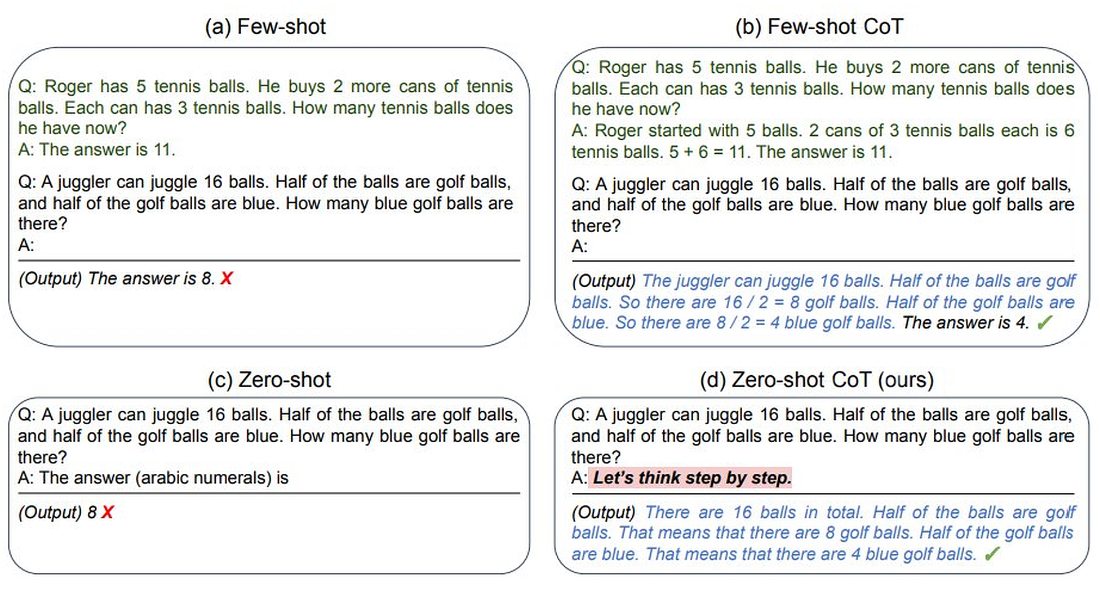
Compare few-shot and zero-shot prompts with their chain-of-thought variants to see where intermediate reasoning enters the prompt. section 2.7.3
Use CoT where the target model benefits from explicit steps, and test it on the actual task. Reasoning models such as the GPT-5 series, o3, or Claude with extended thinking may not need explicit CoT instructions; standard nonreasoning models often benefit on multistep tasks. Visible steps improve inspectability, but they are not a substitute for checking whether the answer is correct. section 2.7.4 section 1.4.1

















