The chain rule finds the derivative of a composite function: a function formed by putting one function inside another. Think of a domino effect: a change in the input affects an intermediate value, which then affects the final result. Multiply the derivatives of those successive steps to find the overall effect. section 9.8 section 9.26
For example, if h(x) = f(g(x)), then h′(x) = f′(g(x)) × g′(x). The first factor describes how f changes at the output of g; the second describes how g changes with x. section 9.8
Tracing a weight’s effect on error
In a neural network, a weight can affect a hidden layer, which affects the predicted output, which affects the cost. Backpropagation follows this chain backward. For a single path, multiply the cost’s sensitivity to the prediction, the prediction’s sensitivity to the hidden value, and the hidden value’s sensitivity to the weight. The result indicates how the cost changes with that weight. If it is positive, decreasing the weight reduces cost locally; if negative, increasing it reduces cost locally. section 9.26
The backward pass starts with the output error and the slope of the activation function. It then calculates gradients: collections of partial derivatives for the weights in a layer. Gradient descent uses these slopes to guide weight updates. section 9.26 section 9.8
Figure 9.27 Weight-update calculation with the Chain Rule
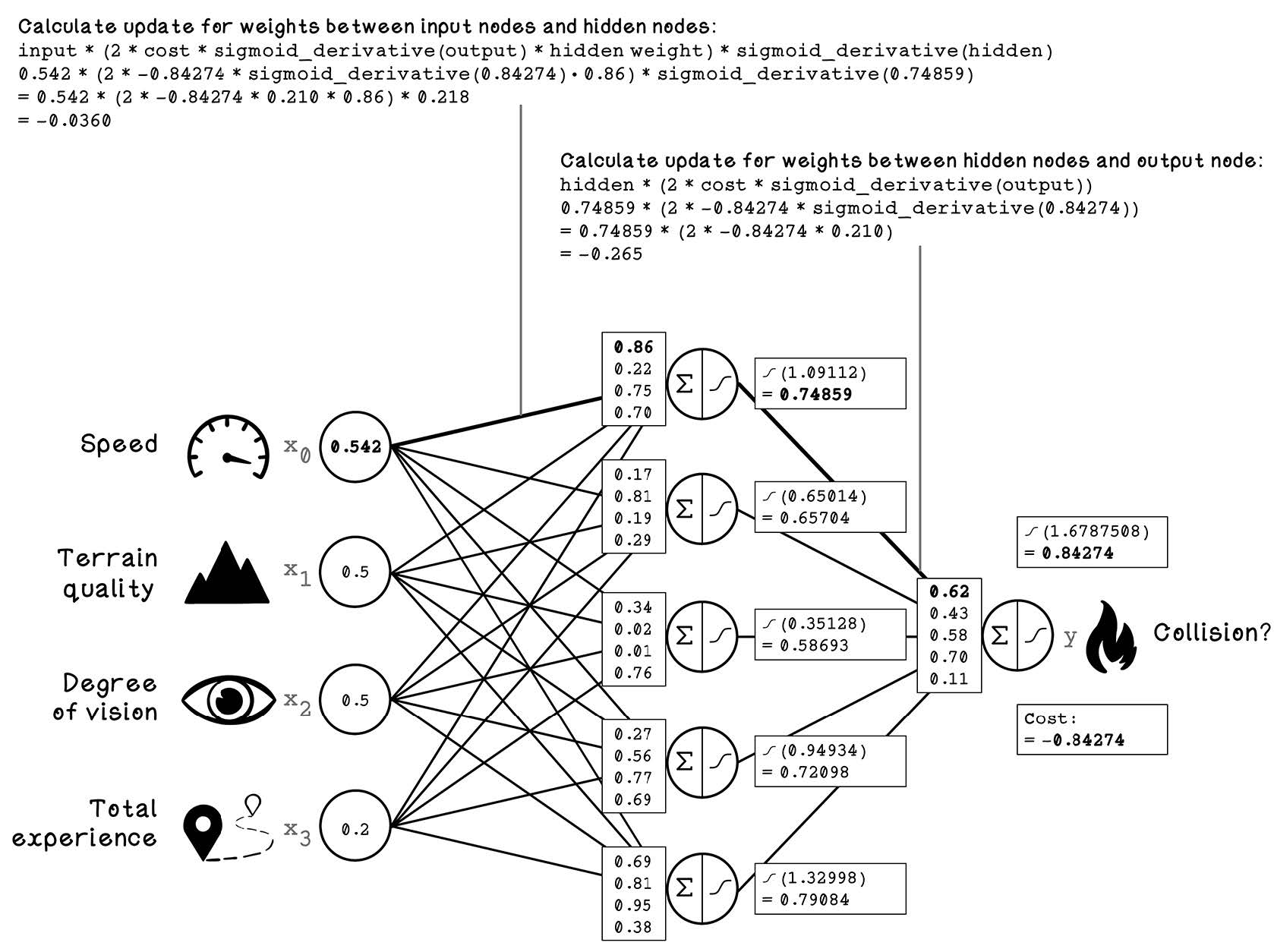
Follow a worked chain-rule calculation for network weight updates. section 9.8



