Challenge-response authentication verifies an account claim by requiring a valid response to a fresh system-provided challenge. Unlike a static password, the challenge and response are derived in real time, allowing control of a secret to be proven without revealing it. section 3.6.4
Fresh, nonreusable exchanges make intercepted responses difficult to reuse. This provides resistance to phishing and replay attacks and supports cryptographic protocols, device authentication, and phishing-resistant authentication flows. section 3.10 section 3.6.4
A public-key challenge-response flow can proceed as follows:
- During registration, associate an identifier with a public key stored by the authentication service. section 3.6.4
- At authentication, submit the identifier and receive a distinct challenge. section 3.6.4
- Sign the challenge with the paired private key and return the signature. section 3.6.4
- Verify the signature with the stored public key without exposing the private key. section 3.6.4
Alice authenticates to ACME
Alice first identifies the account she is claiming. The service sends a challenge; her device signs it with the registered private key, and the service checks the signature using the stored public key. A CAPTCHA is another real-time challenge-response example, but it generally establishes that the requester is human rather than proving control of a particular secret. section 3.6 section 3.6.4
Figure 3.8 Challenge–response authentication flow using public-key cryptography. Alice registers by providing an identifier and a public key. At login, the service sends a challenge, which Alice signs with her private key. The service verifies the signature using the stored public key, confirming heridentity without exposing the private key. This method offers strong resistance to phishing and replay attacks.
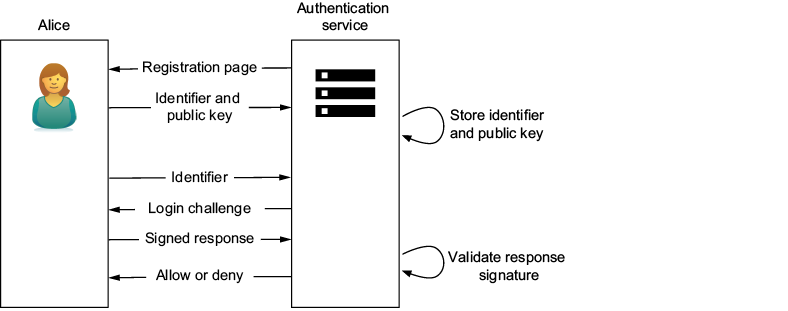
Diagram of registration, challenge delivery, private-key signing, and public-key verification. section 3.6.4
