liveBook · Manning

Predictive analysis engine

As explained in Effective Platform Engineering

A predictive analysis engine is a software system that analyzes data to identify likely future conditions, failures, or weaknesses.

A predictive analysis engine analyzes observability data to identify trends, outliers, anomalies, and weaknesses before they become known problems. Its purpose is to move system knowledge from unknowns into known-knowns, supporting faster resolution and prevention. section 5.1.3

A predictive analysis engine can:

  • Analyze time-series data for trends and outliers. section 5.1.3
  • Highlight anomalies that lead investigators toward root causes. section 5.1.3
  • Use broad, high-quality observability data to find weaknesses and predict discoverable problems. section 5.1.3
Figure 5.3 Knowing what to look for when querying observability data is an evolving process.
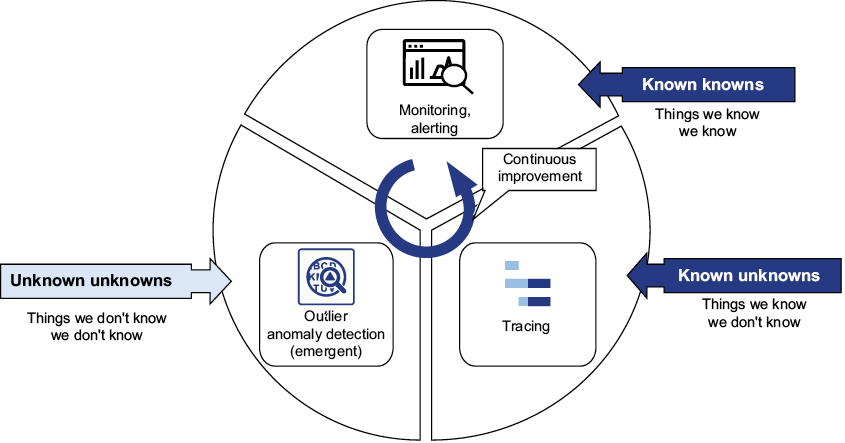
Use the figure to frame predictive analysis as an evolving practice: improving queries and observability expands what teams know to look for. section 5.1.3

How Effective Platform Engineering covers it

How deep it goes
Explains analytical goals and inputs but stops short of specifying an implementation or predictive algorithm.
Examples
Uses trend analysis, outlier analysis, anomaly identification, tracing data, and large language models as examples.
What it assumes
Requires broad, high-quality observability data and an effective tracing strategy.
What you can do after
Diagnose/debug with it by finding weaknesses, resolving discoverable problems faster, and preventing their recurrence.
How it connects
Connects observability, tracing, time-series analysis, anomaly detection, and large language models.

Related concepts

This explainer was generated by Manning's knowledge graph from the text of Effective Platform Engineering. The section links point to the parts of the book it draws on.