A product delivery model organizes how a team continuously delivers and evolves a product around user experience. It treats changing user needs, not one-time project completion, as the basis for product decisions. section 1.3 section 2.1
A durable model connects:
- Developer needs and feedback to the product roadmap. section 1.3
- Growing users, features, and teams to explicit responsibilities and internal product domains. section 1.3
- Self-service capabilities to quality, security, organizational, regulatory, and financial requirements. section 2.1
- Incremental change to an experience that remains valuable as conditions and technologies change. section 2.1
Self-service without isolated responsibility
Ordering a book at breakfast, downloading it to a tablet, and reading within minutes illustrates self-service: the customer experiences simplicity while contractual, regulatory, security, and financial requirements operate behind the scenes. section 2.1
Figure 1.3 Platform engineering depends on the disciplined application of a product delivery model. Product management drives decisions about the product’s capabilities, features, and experiences. Effective platform engineering principles enable us to deliver these more successfully. Identifying and architecting around the internal product domains of our platform is how we successfully sustain the user experience as the product evolves and scales.
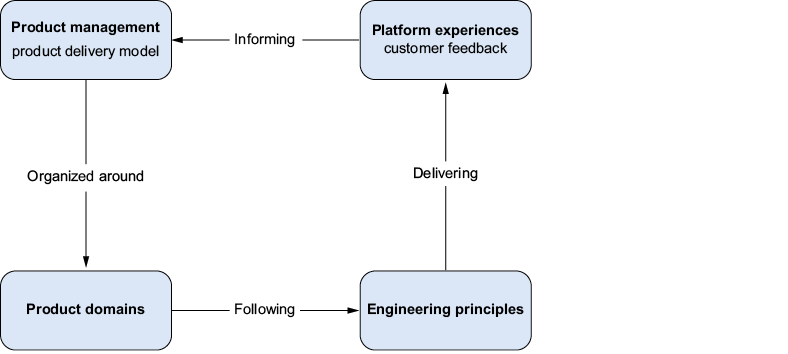
Use the model to connect product-management decisions, platform engineering principles, and internal product domains as the platform scales. section 1.3
