A chapter is a high-level narrative-code unit that coordinates multiple scenes around one coherent larger goal. It advances a broader story arc while allowing more than one aligned plot. section 2.3.4
Figure 2.2 Hierarchical structure of a story
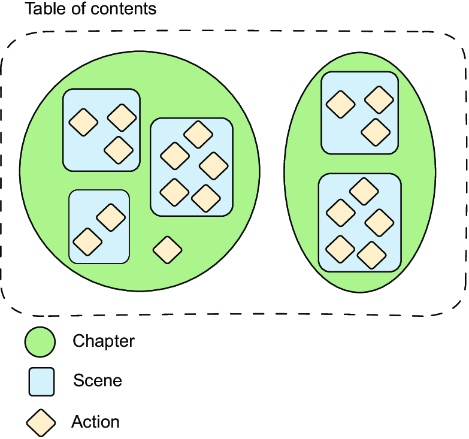
The hierarchy places chapters above scenes and actions, with a table of contents ordering chapters along the full story arc. section 2.3.4
Choose chapter boundaries by balancing:
- Length: split a chapter when its story becomes tedious, but do not extract code merely to reduce line count. section 2.3.5
- Responsibility: keep the chapter’s broader responsibility aligned with one goal, while allowing narrower actions and scenes beneath it. section 2.3.4 section 2.3.5
- Simplicity: extract cognitively heavy conditions or deep nesting into clearly named methods so the chapter remains readable. section 2.3.5
Archiving and delivering
An archiving chapter can express the broader business objective while scenes prepare data and actions perform database operations. A delivering chapter separates preparation from boundary crossing, then brings those scenes together coherently. section 2.3.4
