A filename can exist on disk yet produce “file not found” when one system decodes its bytes with the wrong character encoding. An encoding maps numeric values to symbols; ASCII maps 97 to “a”, so “hello” becomes 104, 101, 108, 108, 111. section 2.1.1 section 2.1.4
The representation has several layers. ASCII uses one byte per symbol. ECMAScript strings instead contain 16-bit unsigned integers, although those values need not correspond to valid symbols; such uninterpreted data is often called a byte string. section 2.1.1 section 2.3
Keep these representation boundaries distinct:
- UTF-8 uses one to four bytes per character for transmission, while UTF-16 uses two to four bytes for JavaScript’s internal representation. section 2.3
- Surrogate pairs combine two 16-bit values for Unicode characters beyond 65,535. section 2.3
- Shift-JIS and UTF-8 apply incompatible mappings, so decoding Shift-JIS bytes as UTF-8 changes the apparent filename. section 2.1.4
Preserving legacy filenames
A Node.js filesystem call initially returned raw directory-entry bytes, then decoded them as UTF-8 and converted them into JavaScript’s UTF-16 representation. For Shift-JIS filenames, that produced names unlike the stored bytes. Returning names as Buffer objects avoids premature interpretation, allowing the application to read files using the original byte sequences. section 2.1.4
Figure 2.1 The ASCII mapping of numbers to symbols. Source: https://en.m.wikipedia.org/wiki/File:ASCII-Table-wide.svg
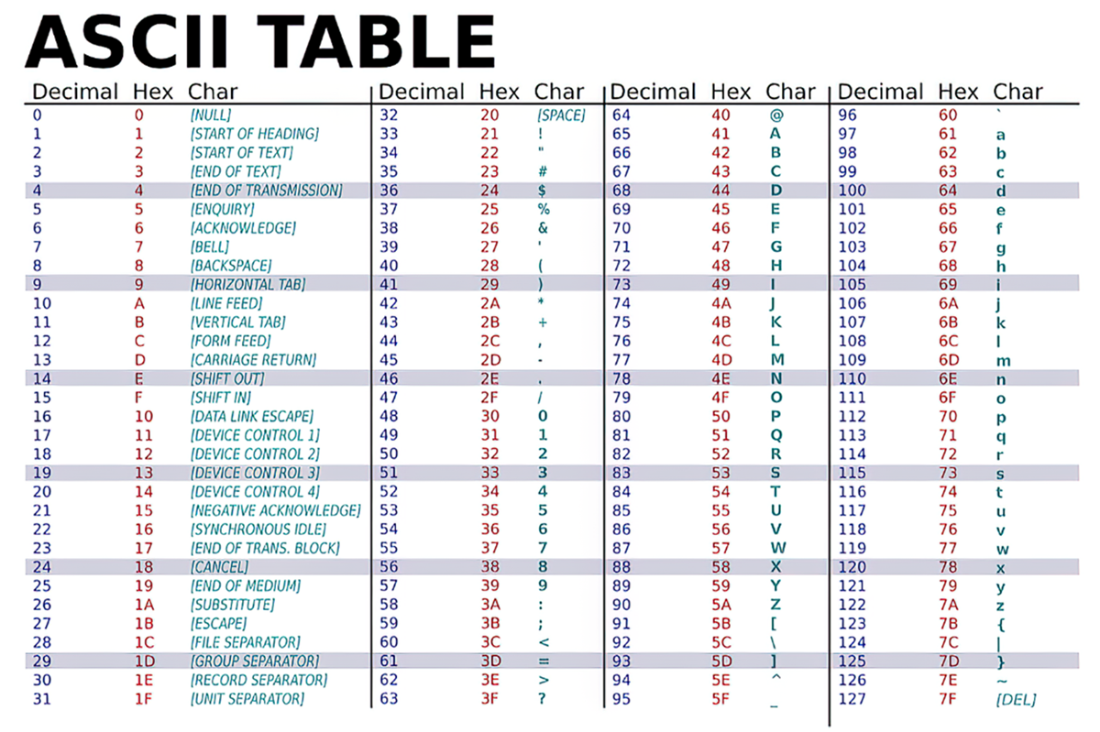
Use the ASCII mapping to inspect how numeric values become visible symbols. section 2.1.1





