Encoder
An encoder is a component or process that transforms input into an encoded or internal representation for subsequent processing, transmission, or decoding.

Build a Text-to-Image Generator (from Scratch)
A sequence encoder is a neural-network component that maps an input sequence to contextualized representations for subsequent processing.
- How it is used
- Supplies representations for translation and caption decoders, image–text similarity, or compressed-image processing.
- How deep it goes
- Builds the transformer encoder through its layers and decoder handoff; demonstrates CLIP and VAE encoders largely through existing models.
- Examples
- Uses German-to-English translation, image captioning, Flickr 8k retrieval, and compression and reconstruction of beaver and dolphin images.
- What you can do after
- Build it from scratch as part of a translation transformer, or apply pretrained encoders to retrieve and compress images.
Read how Build a Text-to-Image Generator (from Scratch) explains encoder →

Build an Advanced RAG Application (From Scratch)
An encoder is a neural-network component that transforms an input sequence into a numerical representation containing information about its content and relationships.
- How it is used
- Supports semantic retrieval by converting documents and queries into comparable dense vectors.
- How deep it goes
- Explains Transformer roles, bidirectional masked-language training, sentence embeddings, model selection, and encoding calls; defers detailed retrieval implementation.
- Examples
- Uses masked-word prediction, climate-article retrieval, hotel-review search, and SentenceTransformer encoding of sample sentences.
- What you can do after
- Apply it via Sentence Transformers to encode text for vector-based semantic search.
Read how Build an Advanced RAG Application (From Scratch) explains encoder →

Build AI Drug Discovery Pipelines
An encoder is a model component that transforms an input into a lower-dimensional representation while retaining selected information.
- How it is used
- Uses encoders to represent molecules for reconstruction and proteins for folding and property prediction.
- How deep it goes
- Explains bottleneck training and embedding preparation, then traces bidirectional GRU and Transformer encoder architectures.
- Examples
- Uses SMILES molecular reconstruction, a bidirectional GRU variational autoencoder, and protein-sequence representations.
- What you can do after
- Understand how molecular encoders prepare sequences and produce latent representations for decoding.
Read how Build AI Drug Discovery Pipelines explains encoder →
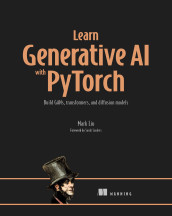
Learn Generative AI with PyTorch
- How it is used
- Uses encoders to prepare image and text representations for reconstruction, translation, denoising, and cross-modal comparison.
- How deep it goes
- Explains dense, convolutional, and Transformer encoder internals with layer structures, tensor shapes, and training objectives.
- Examples
- Uses handwritten-digit reconstruction, face-image generation, English-to-French translation, and paired image–text embeddings.
- What you can do after
- Builds encoders from scratch as parts of autoencoders and translation Transformers, and trains them for their respective tasks.
Read how Learn Generative AI with PyTorch explains encoder →
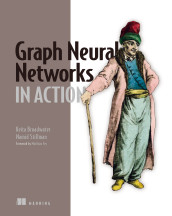
Graph Neural Networks in Action
A model or method that maps an input data object to a lower-dimensional learned representation.
- How it is used
- Compresses graph or temporal sensor data into representations used for edge reconstruction or trajectory prediction.
- How deep it goes
- Defines the mapping, implements a layered GCN encoder, and traces node–edge message passing in a temporal encoder.
- Examples
- Uses a product-link predictor with a GCN encoder and a temporal sensor model that infers connection probabilities.
- What you can do after
- Build it from scratch as a GCN graph-autoencoder component, or implement node–edge encoding for temporal interaction inference.

Deep Learning with Python, Third Edition
The sequence model component that reads the source sequence and compresses it into a representation for another model component to use.
- How it is used
- Uses encoders to supply source representations for translation, image reconstruction, and text-conditioned generation.
- How deep it goes
- Explains encoder outputs and decoder handoffs, with worked GRU and convolutional implementations and a Transformer example.
- Examples
- Uses English-to-Spanish translation, MNIST digit reconstruction, and text-to-image prompt embeddings as examples.
- What you can do after
- Apply encoders with Keras to sequence-to-sequence translation and variational autoencoding.
Read how Deep Learning with Python, Third Edition explains encoder →

Causal AI
An encoder is the component of a representation-learning model that maps observed inputs, optionally with labels or other conditioning variables, to a latent representation.
- How it is used
- Maps observations and optional labels to latent variables for reconstruction, counterfactual inference, or latent-confounder imputation.
- How deep it goes
- Implements distribution-parameter networks and guide functions, then evaluates reconstruction and loss; cautions that learned encodings need not identify causes.
- Examples
- Uses labeled digit-image reconstructions, dSprites shape counterfactuals, and game-purchase data with a latent confounder.
- What you can do after
- Build it from scratch as a conditional PyTorch encoder, or apply pretrained encoders to infer variables for an image counterfactual.

Grokking AI Algorithms, Second Edition
An encoder is a neural-network component that transforms high-resolution input representations into progressively more compact representations of higher-level information.
- How it is used
- Uses encoders to summarize images and turn text labels into representations for image generation.
- How deep it goes
- Traces convolutional feature extraction and group normalization, with a separate downsampling implementation and an overview of the U-Net architecture.
- Examples
- Traces an 8×8 noisy image through eight filters and uses “a happy face” as a text-label embedding example.
- What you can do after
- Evaluate and understand how image encoders extract features and why skip connections help reconstruct detail.
Read how Grokking AI Algorithms, Second Edition explains encoder →

Deep Learning with R, Third Edition
An encoder model transforms an input sequence into an intermediate representation that summarizes information from that sequence.
- How it is used
- Uses encoders to provide representations for sequence generation and image reconstruction.
- How deep it goes
- Works through GRU and convolutional encoder implementations, including decoder initialization and latent distribution parameters.
- Examples
- Uses English-to-Spanish translation and an MNIST digit variational autoencoder.
- What you can do after
- Apply it via R and Keras to construct GRU and convolutional encoders for translation and digit modeling.
Read how Deep Learning with R, Third Edition explains encoder →

Outlier Detection in Python
An encoder is the component of an autoencoder that transforms an input into a compressed representation.
- How it is used
- Compresses inputs into latent representations used for reconstruction-based outlier detection.
- How deep it goes
- Explains shrinking layers and the bottleneck, then shows an image-network definition without deriving encoder training mathematically.
- Examples
- Uses tabular rows, image pixels, and a CIFAR10 image encoder tested on an original and noise-perturbed image.
- What you can do after
- Apply it via TensorFlow Keras and alibi-detect to encode images and examine reconstruction-based outlier scores.

Optimization Algorithms: AI techniques for design, planning, and control problems
An encoder is a neural-network component that transforms each element of an input sequence into a context-dependent hidden representation.
- How it is used
- Transforms sequences or graph nodes into representations consumed by decoders, attention mechanisms, or downstream prediction tasks.
- How deep it goes
- Explains recurrent processing, hidden states, graph mappings, and training examples, but does not derive encoder equations in detail.
- Examples
- Uses convex-hull point sequences, pointer selection, graph node embeddings, Cora data, and graph convolutional networks.
- What you can do after
- Apply via PyTorch or PyTorch Geometric by training sequence or graph models that generate hidden or embedding representations.

Generative AI in Action
A text encoder is a neural-network component that converts textual input into an internal vector representation.
- How it is used
- Uses encoders to represent inputs for language generation, retrieval, and image systems.
- How deep it goes
- Explains input representations and downstream encoder roles at an architectural level, without implementation code or mathematical derivations.
- Examples
- Illustrates query encoding for enterprise document retrieval and prompt encoding for Stable Diffusion image generation.
- What you can do after
- Evaluate and understand where encoder representations fit in generation and retrieval workflows.

Math and Architectures of Deep Learning
The neural-network component that maps an input to a latent-space distribution.
- How it is used
- Maps inputs into compact latent representations for reconstruction, representation learning, and generative modeling.
- How deep it goes
- Explains convolutional architecture, latent distributions, reparameterized sampling, and reconstruction and KL-divergence losses.
- Examples
- Uses convolutional image encoders, PyTorch modules, MNIST digits, Gaussian latent distributions, and two-dimensional latent-space plots.
- What you can do after
- Build an encoder-based autoencoder or VAE with PyTorch and train it through reconstruction and regularization losses.
Read how Math and Architectures of Deep Learning explains encoder →

Inside Deep Learning: Math, Algorithms, Models
The part of a sequence model or autoencoder that transforms an input sequence into an internal representation for downstream decoding.
- How it is used
- Transforms raw inputs into compact representations for reconstruction, downstream machine-learning tasks, or sequence generation.
- How deep it goes
- Explains latent representations, bottlenecks, PCA weight sharing, noise injection, and RNN hidden-state transfer down to implementation patterns.
- Examples
- Uses bottleneck networks, PCA, 28×28 image autoencoders, Gaussian-noise reconstruction, dropout, and sequence translation.
- What you can do after
- Build it from scratch in PyTorch using linear layers, bottlenecks, shared transpose weights, noise layers, or recurrent sequence encoders.
Read how Inside Deep Learning: Math, Algorithms, Models explains encoder →
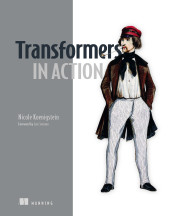
Transformers in Action
An encoder is the sequence-to-sequence component that processes an input sequence and produces a representation for a decoder.
- How it is used
- Uses encoders to supply decoder context for translation and prepare modality-specific inputs for joint processing.
- How deep it goes
- Explains recurrent processing and transformer layer components, including residual connections, normalization, and dropout, with a simplified layer listing.
- Examples
- Illustrates English-to-French translation and vision and audio encoders feeding multimodal representations.
- What you can do after
- Evaluate/understand how recurrent, transformer, and modality-specific encoders prepare inputs for downstream processing.
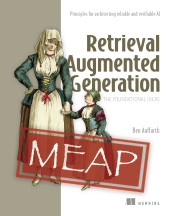
Retrieval Augmented Generation, The Foundational Ideas
An encoder is a model component that transforms an input sequence into a numerical representation.
- How it is used
- Transforms questions and passages into representations for retrieval ranking or decoder-based answer generation.
- How deep it goes
- Explains vector-space movement, independent self-attention, tensor shape, reshaping, and decoder cross-attention.
- Examples
- Uses question-title-context inputs, multiple retrieved passages, vector ranking, and the FiD tensor shape [N, sequence_length, hidden].
- What you can do after
- Evaluate/understand how encoding changes retrieval rankings and how FiD exposes multiple passage representations to a decoder.
Read how Retrieval Augmented Generation, The Foundational Ideas explains encoder →

Knowledge Graphs and LLMs in Action
An encoder is a model component that transforms input data into a learned representation, such as vectors.
- How it is used
- Builds graph embeddings for downstream link prediction, similarity analysis, recommendation, or graph-property reconstruction.
- How deep it goes
- Explains inputs, representation choices, random walks, neighbor aggregation, and encoder–decoder training, but not detailed optimization mathematics.
- Examples
- Uses Node2Vec on the karate club network and heterogeneous user–movie recommendation with learned and genre-based embeddings.
- What you can do after
- Builds encoders that combine embeddings with graph neural networks and supplies representations to a decoder for link prediction.
Read how Knowledge Graphs and LLMs in Action explains encoder →
Evolutionary Deep Learning: Genetic algorithms and neural networks
An encoder is a model component that transforms an input into a lower-dimensional or otherwise compressed representation.
- How it is used
- Compresses images into latent representations that an autoencoder can decode for reconstruction or generative learning.
- How deep it goes
- Explains convolution, pooling, bottlenecks, and evolutionary layer encoding, but defers detailed training and latent-space analysis.
- Examples
- Uses Fashion-MNIST, a Keras convolutional autoencoder, and randomly generated genetic architectures inspected through model summaries.
- What you can do after
- Build it from scratch as a Keras encoder, compile it within an autoencoder, or generate and inspect evolutionary architectures.
Read how Evolutionary Deep Learning: Genetic algorithms and neural networks explains encoder →

LLMs in Production
An encoder is the context-processing component of a transformer architecture that converts input tokens into contextual representations.
- How it is used
- Supports natural language understanding, classification, and feature engineering by processing input at a high level.
- How deep it goes
- Explains embeddings, self-attention, positional encoding, and encoder-decoder roles, but stops short of detailed layer internals.
- Examples
- Uses the red-and-brown sentence, BERT, classification, and named entity recognition to illustrate encoder behavior.
- What you can do after
- Evaluate/understand when encoder-oriented representations fit understanding tasks better than decoder generation or full-transformer workflows.

Hugging Face in Action
A text encoder is a neural network component that converts textual input into an internal numerical representation.
- How it is used
- Supports input comprehension for sentence classification, named entity recognition, and multimodal image-text matching.
- How deep it goes
- Explains encoder inputs, embeddings, positional information, attention, and feed-forward layers at a high level.
- Examples
- Demonstrates CLIP matching an image against the text labels cat, dog, tiger, and train.
- What you can do after
- Apply a transformer-based text encoder through CLIP to compare textual labels with visual content.
Time Series Forecasting Using Foundation Models
An encoder is the sequence-processing component of a transformer that receives token representations and transforms them into contextual representations.
- How it is used
- Processes embedded historical sequences into contextual representations that support transformer forecasting.
- How deep it goes
- Explains stacked layers, self-attention, and multiheaded attention, but defers their mathematical details.
- Examples
- Illustrates nearby-token attention and separate attention heads for trends and seasonal patterns in time series.
- What you can do after
- Evaluate/understand how encoder representations support autoregressive time-series predictions.
Read how Time Series Forecasting Using Foundation Models explains encoder →
Transfer Learning for Natural Language Processing
An encoder is a model component that transforms an input sequence into an internal representation.
- How it is used
- Transforms input sequences into context representations for decoders and text into numbers in pretrained tabular-data workflows.
- How deep it goes
- Defines the encoder's representation role and shows pretrained configuration and data limits, without detailing the encoder's computation.
- Examples
- Uses machine translation and SIMOn tabular-data preprocessing to illustrate encoder roles.
- What you can do after
- Apply it via SIMOn's pretrained encoder by loading its configuration and matching the maximum cell count and length.
Read how Transfer Learning for Natural Language Processing explains encoder →

Introduction to Generative AI, Second Edition
An encoder is a model component that transforms input data into a compressed or otherwise structured representation.
- How it is used
- Supports synthetic-media workflows by compressing images into representations that decoders use to reconstruct or alter faces.
- How deep it goes
- Defines compression, latent features, and reconstruction, then sketches face-swapping mechanics without implementation detail.
- Examples
- Uses facial expressions, face angles, skin tones, and two-face swapping to make the representation concrete.
- What you can do after
- Evaluate/understand how an encoder separates image characteristics from the decoder that reconstructs or blends faces.
Read how Introduction to Generative AI, Second Edition explains encoder →

Data Without Labels
An encoder is a model component that maps an input into a lower-dimensional or otherwise transformed representation.
- How it is used
- Compresses input data into learned representations for dimensionality reduction, reconstruction, anomaly detection, and data compression.
- How deep it goes
- Explains the encoder’s neural-network role, bottleneck interaction, dataset specificity, and training hyperparameters without detailing individual layer implementations.
- Examples
- Uses flower-versus-traffic-signal images, compressed code sizes, and a basic Python Keras autoencoder implementation.
- What you can do after
- Build it from scratch by selecting an encoding method, code size, layer structure, decoding method, and reconstruction loss.

Natural Language Processing in Action, Second Edition
An encoder is the transformer component that transforms an input sequence into contextual representations through stacked attention and feedforward layers.
- How it is used
- Transforms token embeddings into reusable sequence representations within an encoder–decoder transformer.
- How deep it goes
- Defines stacked attention and feedforward layers with linear projections and normalization, but stops at architectural description.
- Examples
- Uses the original six-layer Transformer and BERT’s bidirectional masked-token prediction as concrete architectural examples.
- What you can do after
- Evaluate encoder placement, layer composition, and its contrast with decoder-only GPT architectures.
Read how Natural Language Processing in Action, Second Edition explains encoder →
Applied Reinforcement Learning
A model component that transforms input into a representation suitable for downstream processing or decision-making.
- How it is used
- Converts unstructured inputs into structured state that an agent can use for decisions.
- How deep it goes
- Explains the representation boundary, deployment pattern, and fidelity monitoring without detailing encoder internals.
- Examples
- Uses robot instructions and camera frames, supply-chain disruptions, and clinical notes as encoding examples.
- What you can do after
- Apply it via a fine-tuned model to encode unstructured inputs as state for a decision agent.

Timeless Algorithms, The Foundational Ideas
A communication-system component that converts a message into a form suitable for transmission.
- How it is used
- Prepares messages for communication channels and creates compact representations for subsequent learning, recognition, or reconstruction.
- How deep it goes
- Explains compression and structured redundancy, then describes latent representations and reconstruction without detailing encoder internals.
- Examples
- Uses image compression and mentions compact representations for language, speech, and audio.
- What you can do after
- Evaluate representations by whether they preserve useful information while discarding redundancy.
Read how Timeless Algorithms, The Foundational Ideas explains encoder →
Machines that Think
A sequence-processing component that transforms an input sequence into internal representations using attention over the available input.
- How it is used
- Transforms data into internal representations for reconstruction in autoencoders or contextual sequence processing in Transformers.
- How deep it goes
- Explains compression and unrestricted self-attention, contrasting encoder and decoder roles without detailing implementation.
- Examples
- Uses compressed image patterns and whole-sentence token relationships to illustrate distinct encoder roles.
- What you can do after
- Understand how encoder roles differ between autoencoders and Transformers, and how attention access distinguishes Transformer encoders from decoders.
Also covered in
- Machine Learning System Design
- Deep Learning with PyTorch, Second Edition
- Machine Learning Algorithms in Depth
- Financial AI in Practice
What to know first
- language modelA language model is a computational model that represents patterns in linguistic sequences to assign probabilities, predict, generate, or evaluate language.
- embeddingAn embedding is a numerical vector representation of an item in a feature space, encoding selected properties or relationships for computational tasks such as comparison or retrieval.
- transformer architectureA transformer is a neural-network architecture that uses attention-based interactions and position-wise transformations to model relationships among elements of sequences or other structured inputs.
- linear layerA linear layer is a neural-network layer that applies a learned affine transformation to its input, typically using weights and a bias.
Related concepts
- transformer architecturepart of · A transformer is a neural-network architecture that uses attention-based interactions and position-wise transformations to model relationships among elements of sequences or other structured inputs.
- autoencoderpart of · An autoencoder is a neural network that encodes input data into an internal representation and decodes it to reconstruct the input or an approximation.
- embeddingproduces · An embedding is a numerical vector representation of an item in a feature space, encoding selected properties or relationships for computational tasks such as comparison or retrieval.
- variational autoencoderpart of · A variational autoencoder is a generative neural network that learns a probabilistic latent representation of data and decodes samples from it to reconstruct or generate data.
- CLIPpart of · CLIP is a multimodal model and pretraining method that aligns image and text representations in a shared embedding space.
Questions about encoder
What is encoder?
An encoder is a component or process that transforms input into an encoded or internal representation for subsequent processing, transmission, or decoding.
Which Manning books explain encoder?
Build a Text-to-Image Generator (from Scratch), Build an Advanced RAG Application (From Scratch), Build AI Drug Discovery Pipelines, Learn Generative AI with PyTorch, Graph Neural Networks in Action, Deep Learning with Python, Third Edition, Causal AI, Grokking AI Algorithms, Second Edition and 20 more.
What should I know before learning encoder?
Manning books that teach encoder usually introduce language model, embedding, transformer architecture and linear layer first.
What is encoder part of?
Encoder is part of transformer architecture. A transformer is a neural-network architecture that uses attention-based interactions and position-wise transformations to model relationships among elements of sequences or other structured inputs.
These guides are generated from the text of Manning books by Manning's knowledge graph and link to the sections they draw on. The full books are available on liveBook and at manning.com.