liveBook · Manning

Encoder

As explained in Introduction to Generative AI, Second Edition

An encoder is a model component that transforms input data into a compressed or otherwise structured representation.

An encoder transforms input data into a compressed representation that preserves important patterns. For images, this representation is called latent features or a latent representation; a decoder can use it to reconstruct the image. section 4.2

In image-generation and synthetic-media systems, an encoder:

  • Extracts patterns such as facial expressions, face angles, skin tones, eyes, noses, mouths, and lighting. section 4.2
  • Passes those patterns to a decoder, which reconstructs an image from the compressed representation. section 4.2
  • Can support face-swapping systems that use one encoder with separate decoders trained for different faces. section 4.2
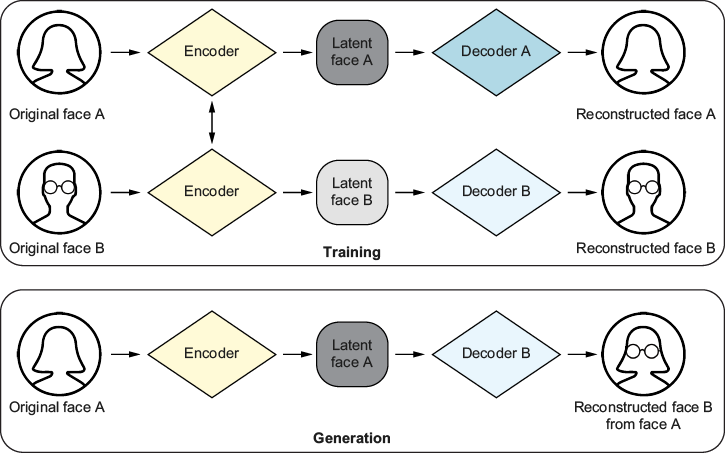
Figure 4.2 Deepfake creation using autoencoders with a single encoder and two decoders

A diagram of deepfake creation using one encoder and two decoders makes the separation between feature extraction and reconstruction visible. section 4.2


How Introduction to Generative AI, Second Edition covers it

How deep it goes
Defines compression, latent features, and reconstruction, then sketches face-swapping mechanics without implementation detail.
Examples
Uses facial expressions, face angles, skin tones, and two-face swapping to make the representation concrete.
What you can do after
Evaluate/understand how an encoder separates image characteristics from the decoder that reconstructs or blends faces.
How it connects
Connects to autoencoders, decoders, latent representations, deepfakes, generative adversarial networks, and diffusion models.

Also explained in

Compare how 21 books explain encoder →

Related concepts

This explainer was generated by Manning's knowledge graph from the text of Introduction to Generative AI, Second Edition. The section links point to the parts of the book it draws on.

















