An encoder is a fully connected neural-network component that transforms input data into a smaller, compressed representation. In an autoencoder, it passes information to a bottleneck, which retains the most important representations before reconstruction by the decoder. section 9.4
An encoder participates in an autoencoder workflow:
- Pass input data through the encoder to reduce its size. section 9.4
- Restrict information through the bottleneck so only important attributes pass forward. section 9.5
- Use the decoder to reconstruct the input and compare reconstructed values with the originals. section 9.4
Choosing the compressed representation
Reducing the code size creates stronger compression and can regularize the model. An autoencoder trained on flower images learns features specific to that dataset and may not compress traffic-signal images effectively. section 9.5 section 9.4
Figure 9.1 Structure of an autoencoder with an encoder, a bottleneck, and a decoder
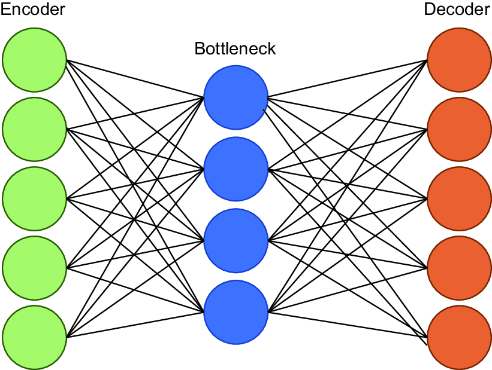
Trace the encoder’s position between the input and bottleneck, then follow reconstruction through the decoder. section 9.4




















