A retrieval system can return near-duplicates that repeat a question’s wording while missing the passage that answers it. An encoder transforms text into numerical vectors; changing its weights changes the vector space, so nearest-neighbor search can rank useful passages above lookalikes. section 3.0
In Fusion-in-Decoder, the encoder processes each question-and-passage input independently and in parallel. Self-attention stays inside each sequence, producing N representations with shape [N, sequence_length, hidden]. A reshape lays them end to end; the decoder then uses cross-attention across the resulting sequence to synthesize an answer. section 5.2
The encoder’s role differs across retrieval-augmented designs:
- In a trained retriever, encoder weights move questions and passages in vector space so instrumental usefulness can influence ranking. section 3.0
- In FiD, each retrieved passage receives a separate question-plus-passage encoding, while the decoder performs the cross-passage fusion. section 5.2
Encoding a retrieved passage
For the question “Where was T5 developed?”, one encoder input combines question:, title:, and context: segments with a single retrieved passage. Repeating this structure for N passages yields independent representations for decoder conditioning. section 5.2
Figure 5.2 The FiD architecture: Independent Encoding, Fused Decoding.
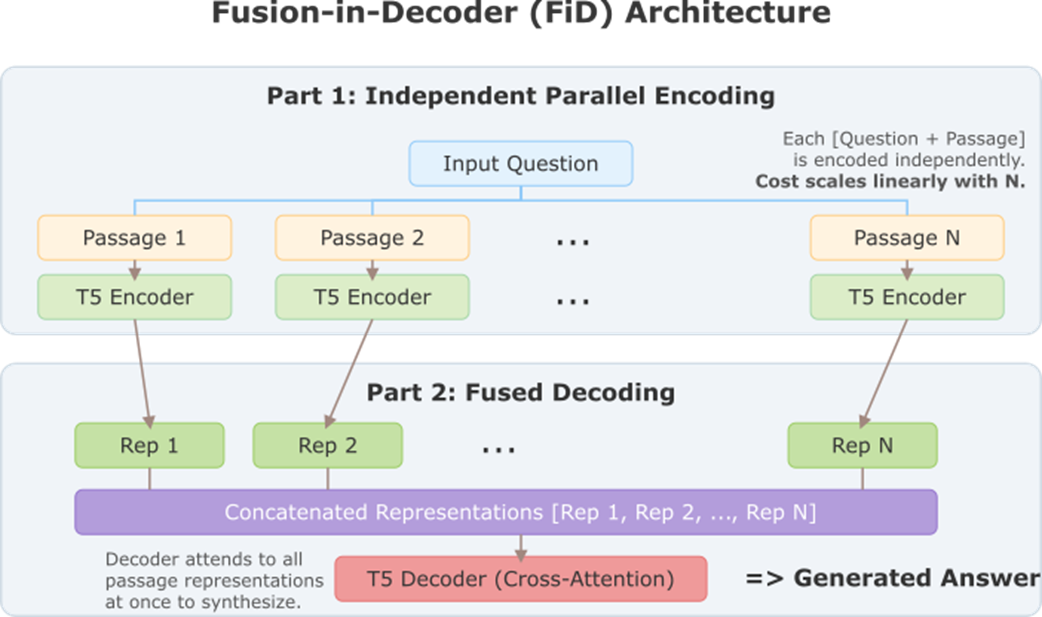
Diagram the separation between independent passage encoding and fused decoder attention. section 5.2
Table 5.2 Comparison between Retrieval-Extractive, Closed-Book Generative, and FiD
|
Aspect
|
Retrieval-Extractive (DrQA)
|
Closed-book Generative (T5)
|
Fusion-in-Decoder (hybrid)
|
|
Core idea
|
Retrieve candidate passages, then extract a text span from
each passage with a reader.
|
Store knowledge in model parameters; generate an answer
directly from the model (no retrieval at inference).
|
Retrieve multiple passages, encode them, then use a
generative decoder that conditions on all encodings to synthesize an answer.
|
|
Knowledge source
|
External corpus (Wikipedia, web) queried at inference
time.
|
Implicitly, in the model weights learned during
pretraining.
|
External corpus + generative decoder — external knowledge
retrieved at inference, fused by decoder.
|
|
Reader/Architecture
|
Separate retriever + extractive reader (span prediction
per passage).
|
Encoder-decoder Transformer trained in text-to-text
fashion (generative).
|
Retriever + encoder for each passage; decoder attends over
concatenated/encoded passages.
|
|
Answer format
|
Literal span from a retrieved passage (extractive).
|
Abstractive, free-form text (can paraphrase or
synthesize).
|
Abstractive, but grounded in retrieved passages; can
combine evidence across passages.
|
Compare encoder-based retrieval-generation designs with extractive readers and closed-book generation. section 5.2



























