An encoder converts a message into a form suited to its next stage. In communication, it prepares messages for a channel: it may remove predictable redundancy to reduce transmission needs, add structured redundancy to resist noise, or do both. section 5.2
Figure 5.2 Shannon's framework of communication. An information source generates messages with varying degrees of unpredictability and passes them to an encoder, which converts the message into signals for transmission over a channel subject to noise. A decoder reconstructs the message from the received signal, and a receiver interprets the result. By separating communication into these stages, Shannon showed how uncertainty, redundancy, and reliability could be analyzed and optimized within the limits imposed by the communication channel.
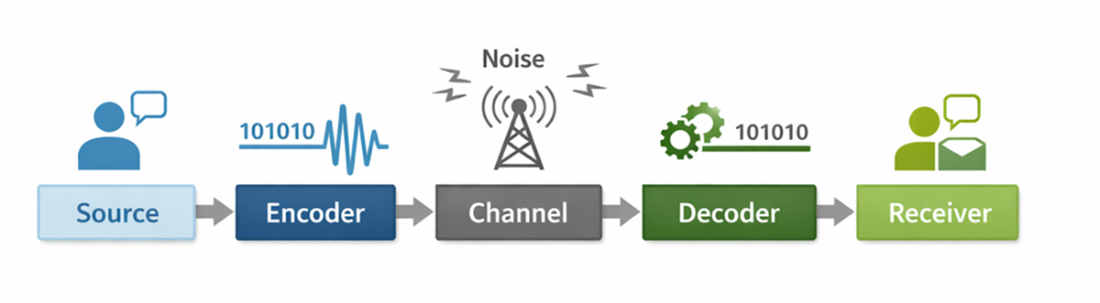
Trace the encoder’s place between information source and noisy channel, alongside the decoder and receiver. section 5.2
In representation learning, an encoder compresses data into a latent representation. The aim is not simply to make data smaller: the representation should preserve information useful for recognition or reconstruction while discarding predictable detail. section 5.4.2
Image representations
For a high-resolution image, an encoder can reduce redundant pixel detail while retaining informative edges, textures, and shapes. A decoder can use the compact representation to reconstruct an image that resembles the original. section 5.4.2
Figure 5.3 Representation learning as information-preserving compression. An encoder transforms a high-dimensional image into a compact latent representation by preserving the image's informative structure while reducing redundant detail. Although many original pixels are no longer represented explicitly, the latent representation retains the information needed for a decoder to reconstruct an image that closely resembles the original.
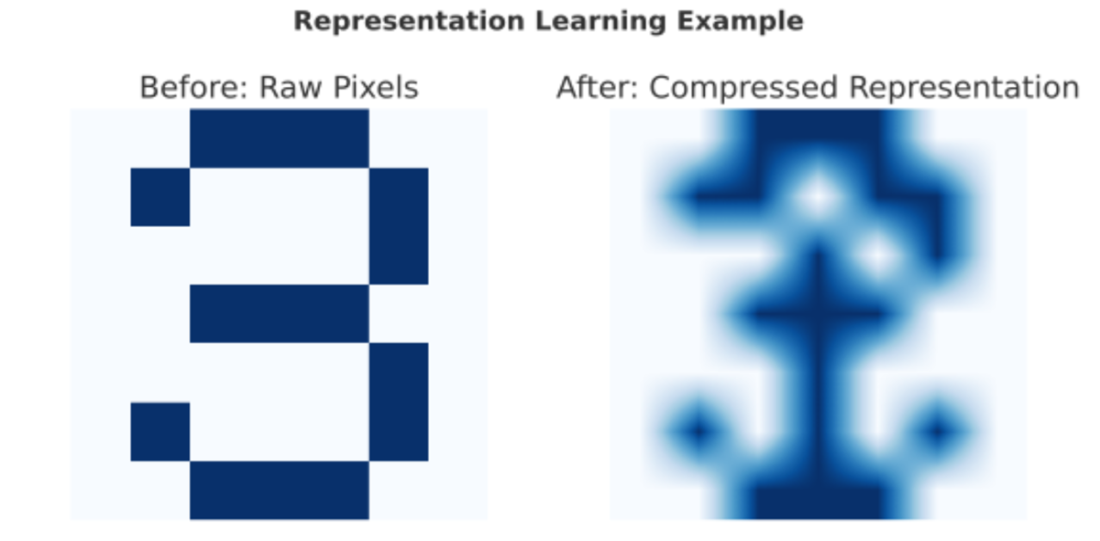
See how an image encoder reduces redundant detail while retaining structure for reconstruction. section 5.4.2