liveBook · Manning

Checklist

As explained in Data-Oriented Programming in Java

A checklist is an ordered set of actionable items whose completion can be explicitly marked to control execution of a complex process.

A checklist is an ordered set of actionable items whose completion can be explicitly marked. In rocket manufacturing, checklists control complex work because important steps must not depend on memory. section 4.1 section 4.1.1

A reusable checklist has two phases: defining a template for the work, then running instances of that template to perform and record the work. section 4.1.1 section 4.1.3

Model the checklist by separating stable instructions from run-specific state:

  • Represent each actionable item as a Step with a name. section 4.1.3
  • Represent a Template as a named collection of steps. section 4.1.3
  • Represent an Instance as a named, dated run-through of a template. section 4.1.3
  • Represent completion as Status associated with an instance and a step. section 4.1.3

International travel checklist

A template can contain steps such as Passport, Toothbrush, and Bring socks. Completion belongs to a particular run rather than to the reusable template, so a new instance starts with its own status. section 4.1.3

Figure 4.1 The checklist!
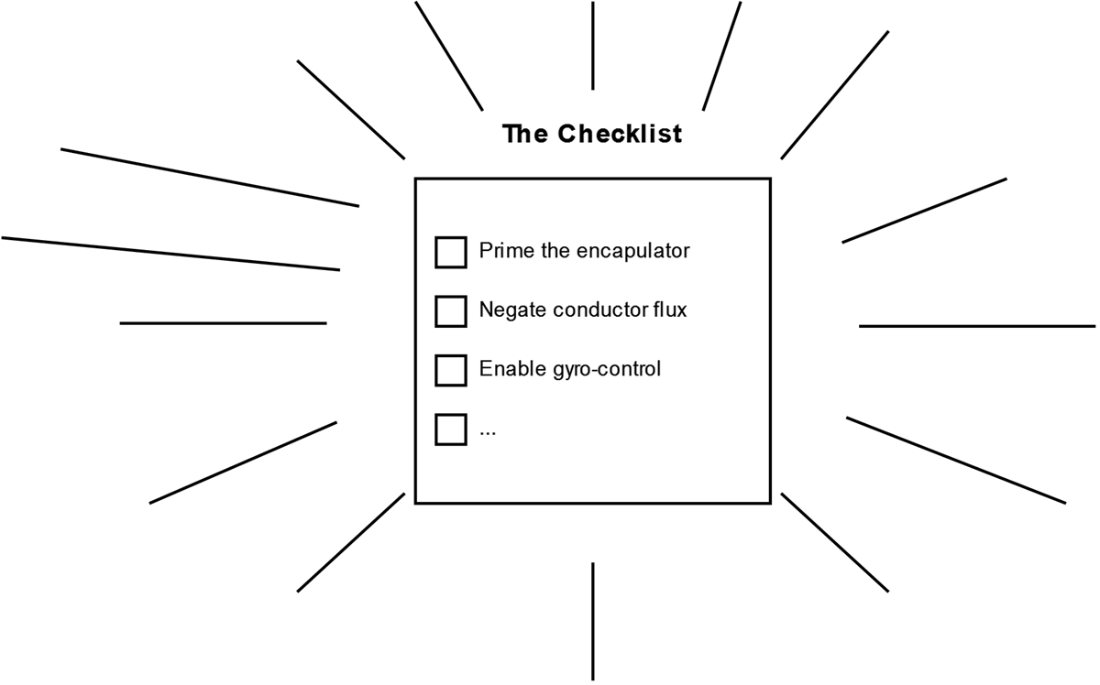
Use the checklist figure to anchor the distinction between labeled items and their explicitly marked completion state. section 4.1.1


How Data-Oriented Programming in Java covers it

How deep it goes
Derives a data model from loose requirements, iteratively refining records until template, instance, step, and status meanings align.
Examples
Uses rocket manufacturing and an international travel checklist to expose the difference between reusable plans and completed runs.
What it assumes
Starts from a loose requirement and teaches the domain distinctions needed to model checklist data precisely.
What you can do after
Builds a domain model that prevents completion state from being confused with reusable checklist instructions.
How it connects
Connects checklists to templates, instances, steps, status, records, sealed interfaces, and algebraic data types.

Also explained in

Compare how 5 books explain checklist →

Related concepts

This explainer was generated by Manning's knowledge graph from the text of Data-Oriented Programming in Java. The section links point to the parts of the book it draws on.


