liveBook · Manning

Checkpointing

As explained in Building Reliable AI Systems

The practice of saving execution state so a process can be paused and later resumed.

Checkpointing saves agent execution state so work can pause and resume. In a harness–sandbox setup, the harness can restore state after a sandbox crash and continue from the last checkpoint. LangGraph provides checkpointing as part of its state management for production agents. section 6.2.2 section 7.9.1

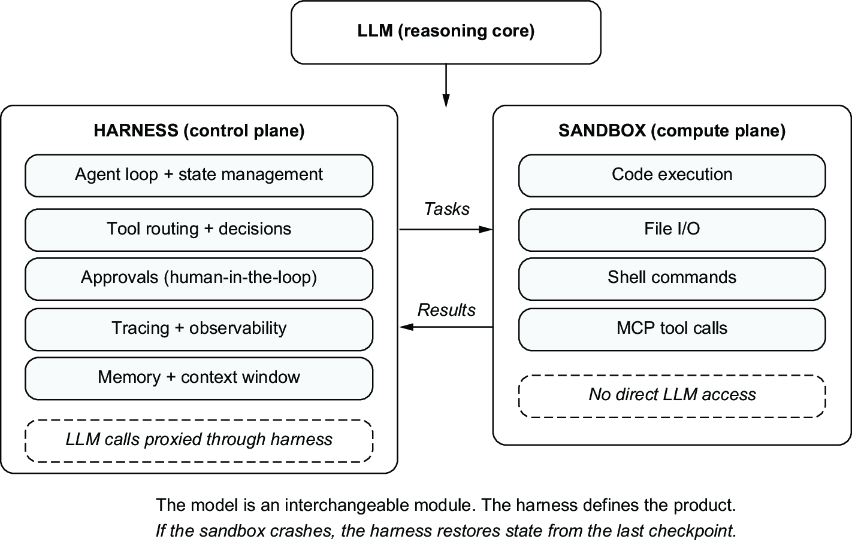
Figure 7.4 The harness owns the agent loop, memory, and LLM communication. The sandbox executes code in isolation with no direct model access. Tasks flow right; results flow left. If the sandbox crashes, the harness recovers.
figure

Shows the harness and sandbox roles, including recovery when the sandbox crashes. section 7.9.1

How Building Reliable AI Systems covers it

How deep it goes
Connects checkpointing to pause, resume, and crash recovery, but does not detail checkpoint formats or save-and-restore procedures.
Examples
Uses a sandbox crash as the recovery case: restore harness state and continue from the last checkpoint.
What you can do after
Understand how an agent harness can recover execution after a sandbox crash using the last checkpoint.
How it connects
Links checkpointing with agent state management, harnesses, and sandboxed execution.

Also explained in

Compare how 6 books explain checkpointing →

Related concepts

This explainer was generated by Manning's knowledge graph from the text of Building Reliable AI Systems. The section links point to the parts of the book it draws on.




