liveBook · Manning

Checkpointing

As explained in AI Agents and Applications

A checkpoint is a designated point in a process at which its state or progress is recorded or evaluated, often to support recovery, continuation, or control.

Checkpointing saves snapshots of a graph’s execution state at specific points. In LangGraph, snapshots are taken at each super-step; unlike message-only storage, they preserve the broader graph state. This supports conversational continuity, recovery after failure, and workflows that pause for human input. section 14.1.3

To persist a LangGraph assistant’s state across chat turns:

  • Create a thread ID once per conversation and pass it in the RunnableConfig with each graph invocation. section 14.1.4
  • Compile the graph with a checkpointer, such as InMemorySaver. For production, use persistent storage so state survives restarts and can be shared across application instances. section 14.1.4
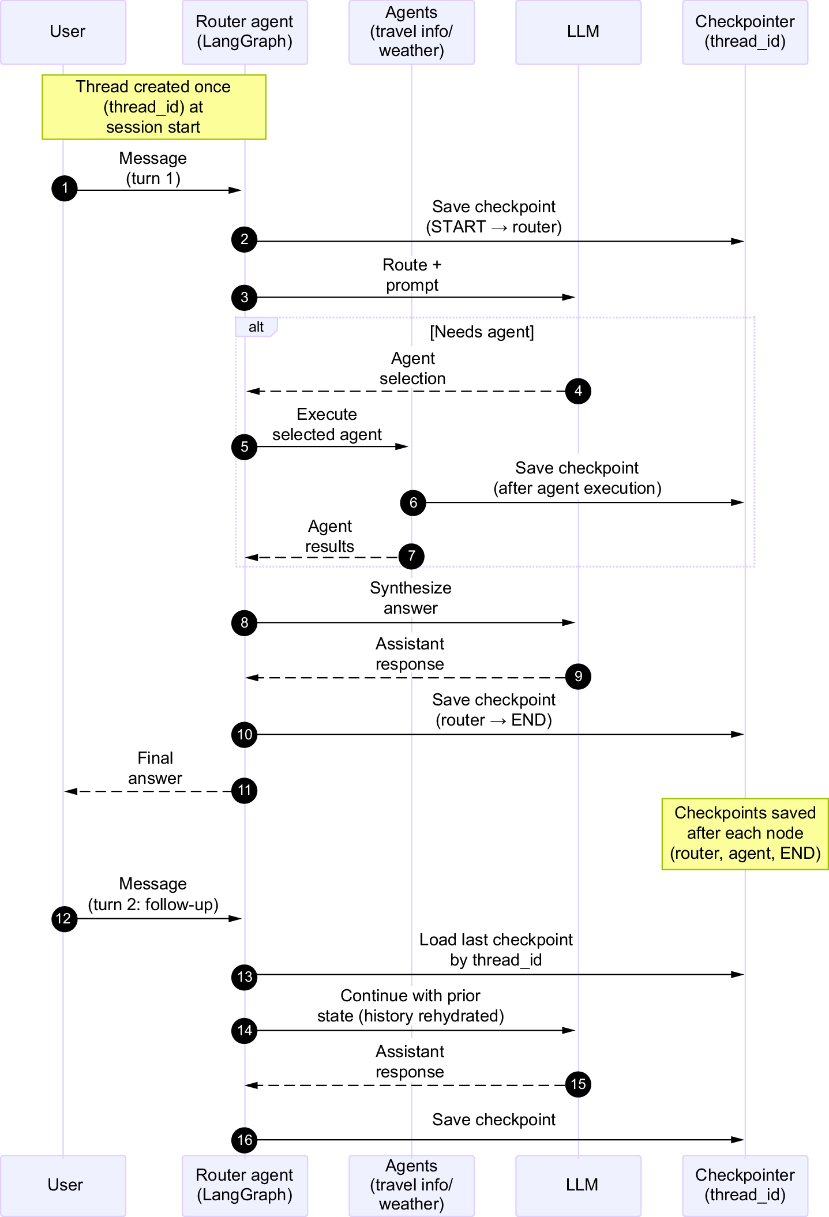
Figure 14.1 Sequence diagram of the travel assistant with checkpoints saved after each node execution, allowing state restoration across turns using a shared thread_id
figure

The sequence diagram shows checkpoints saved after node execution and state restored across turns using a shared thread ID. section 14.1.3


How AI Agents and Applications covers it

How deep it goes
Defines graph-state snapshots at super-steps and sketches recovery and human approval, then walks through conversational persistence setup.
Examples
Uses a router-based travel assistant, a shared thread ID, and InMemorySaver to demonstrate persisted chat turns.
What it assumes
Assumes an existing LangGraph graph and chat loop, then adds session identity and persistence.
What you can do after
Apply LangGraph checkpointing by assigning a thread ID and compiling a graph with a checkpointer to retain conversational state across turns.
How it connects
Connects short-term memory with LangGraph graph state, thread IDs, checkpointers, and human-in-the-loop workflows.

Also explained in

Compare how 6 books explain checkpointing →

Related concepts

This explainer was generated by Manning's knowledge graph from the text of AI Agents and Applications. The section links point to the parts of the book it draws on.



