When a retrieval-augmented generation system cannot find the right passage, its language model lacks the context needed for an accurate response. Chroma provides a practical store for embedded document chunks, allowing retrieval by semantic similarity before response generation. section 6.3.2
A simple ingestion flow
Start with a text file, split it into sentence- or word-based chunks, convert those chunks into embeddings, and load them into Chroma. A user query can then retrieve semantically similar passages for the language model to synthesize into a response. section 6.3.2
A practical Chroma workflow includes:
- Choose a chunking strategy and experiment with chunk size or splitting method. section 6.3.2
- Embed the chunks with an open-source or custom embedding function. section 6.3.2
- Store the resulting vectors in Chroma and evaluate retrieval performance. section 6.3.2
Figure 6.9 RAG uses a vector database during build time and run time.
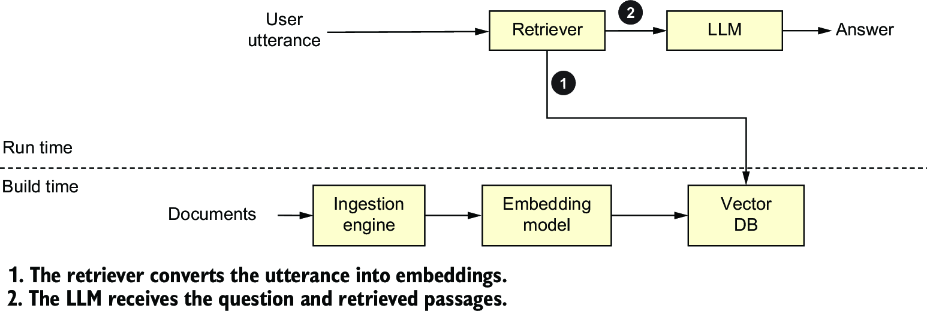
Use the figure to see how a vector database participates in RAG during both build time and run time. section 6.3.2






