liveBook · Manning

Classification error function

As explained in Grokking Machine Learning

An error metric for a two-boundary classifier equal to the sum of the perceptron errors from its two boundary lines.

For a classifier made from two parallel boundaries, the classification error is the sum of the perceptron errors for each boundary. It measures how well the boundaries classify points; the full SVM error also includes a separate distance error. section 11.1

Adding the two boundary errors

For one point, the errors are 10 and 12; adding them gives a classification error of 22. section 11.1

Figure 11.5 Now that our classifier consists of two lines, the error of a misclassified point is measured with respect to both lines. We then add the two errors to obtain the classification error. Note that the error is not the length of the perpendicular segment to the boundary, as illustrated, but it is proportional to it.
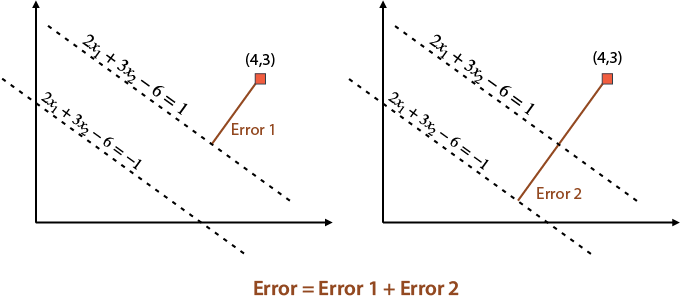
See how a misclassified point’s errors are measured against both boundaries and added; the illustrated perpendicular length is proportional to, but not itself, the error. section 11.1

How Grokking Machine Learning covers it

How deep it goes
Defines the classification component as summed perceptron errors and distinguishes it from the separate distance error.
Examples
Uses two boundary errors, 10 and 12, whose sum is 22.
What it assumes
Builds on perceptron classifiers and their error functions.
What you can do after
Evaluate a two-boundary classifier by adding the perceptron errors from both boundaries.
How it connects
Connects support vector machines with perceptrons and their error functions.

Related concepts

This explainer was generated by Manning's knowledge graph from the text of Grokking Machine Learning. The section links point to the parts of the book it draws on.