Suppose two lines both put a point on the wrong side. Is the mistake equally bad if the point is barely across one line but far across the other? Counting mistakes says yes. The perceptron error function gives the farther-off mistake a larger value. section 5.2
Figure 5.14 The two classifiers misclassify the point. However, the classifier on the right made a much bigger mistake than the classifier on the left. The point on the left is not far from the boundary, and thus, it is not very far from the sad zone. However, the point on the right is very far from the sad zone. Ideally, we would like an error function that assigns a higher error to the classifier in the right than to the classifier in the left.
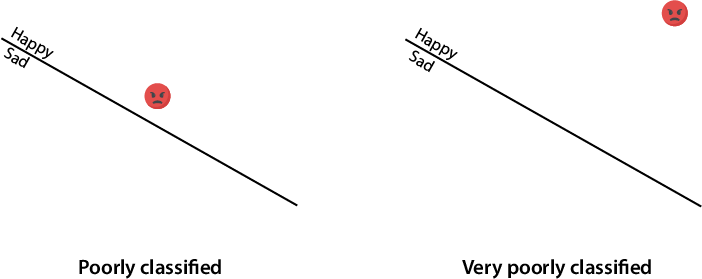
The two classifiers both misclassify a point, but one places it much farther from the boundary. The error function is meant to distinguish those mistakes. section 5.2
A perceptron calculates a score from a point’s features. A score of zero lies on its boundary; positive and negative scores lie on opposite sides. The score’s absolute value grows as a point moves farther from that boundary. Using the score avoids calculating perpendicular distance to the line. section 5.2
For a point with a known label:
- Predict its label from the score: predict 1 when the score is at least zero, otherwise predict 0. section 5.4
- If the prediction is correct, assign error 0. Otherwise, assign the absolute value of the score: error = |score|. section 5.4
- Average the pointwise errors to obtain the mean perceptron error for a dataset. section 5.4
The mean error helps compare classifiers and track training. In one four-point comparison, the mean errors are 1.25 and 0; the second classifier has the lower error. During training, the perceptron trick repeatedly adjusts the classifier, while the mean error tracks its performance. section 5.2 section 5.3 section 5.4
Try a single update
Take the model with score 2x₁ + 3x₂ − 4 and a point (1, 1) labeled 0. Its score is 1, so it is predicted as 1 and has error 1. With learning rate 0.01, the perceptron trick changes the weights to 1.99 and 2.99 and the bias to −4.01. The new score is 0.97: the prediction is still wrong, but its error has fallen to 0.97. Try calculating the change yourself before checking the numbers. section 5.7 section 5.4
