Can word counts help decide whether a sentence sounds happy or sad? A linear classifier first gives the sentence a numerical score, then uses its sign to choose a class. For a simple word-count classifier, give each appearance of “aack” one point and each appearance of “beep” minus one point. Add the points: a positive or zero score predicts happy; a negative score predicts sad. section 5.1
Score a sentence
“Aack beep aack” scores 1 − 1 + 1 = 1, so it is predicted happy. “Beep beep” scores −2, so it is predicted sad. Equal counts score zero and, by this classifier’s chosen rule, predict happy. Try scoring a new sentence before checking which side of the boundary its word counts fall on. section 5.1
More generally, multiply each feature by its weight, add the products, and add a bias: score = w₁x₁ + w₂x₂ + … + wₙxₙ + b. The features might be word counts; the bias shifts the boundary and determines the score when every count is zero. Points scoring zero lie on the decision boundary. Negating every weight and the bias keeps the boundary but swaps its positive and negative sides. section 5.1 section 5.6
Figure 5.3 The classifier is the diagonal line that splits the happy and the sad points. The equation of this line is xaack = xbeep (or equivalently, xaack – xbeep = 0), because the line corresponds to all the points where the horizontal and the vertical coordinates are equal. The happy zone is the zone in which the number of appearances of aack is greater than or equal to the number of appearances of beep, and the sad zone is the zone in which the number of appearances of aack is less than that of beep.
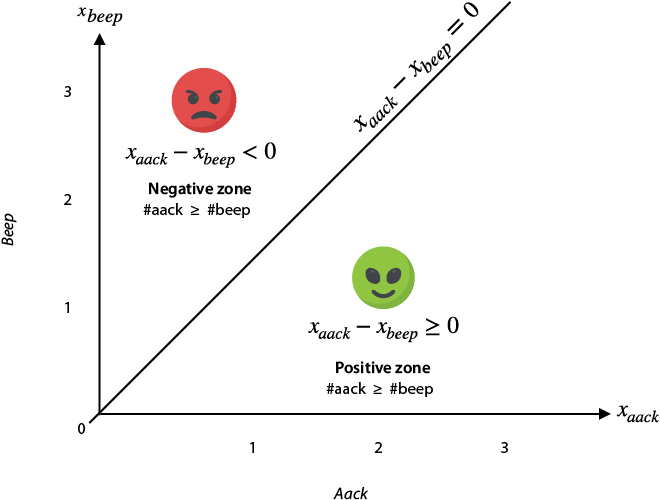
The word-count plot makes the score’s sign visible: equal counts form the zero-score line, with positive and negative predictions on opposite sides. section 5.1
A score carries more information than the final category. If the true label is sad, scores of 1 and 100 are both mistakes, but the latter signals a much larger error for that classifier. Counting mistakes alone misses this difference. Geometrically, a misclassified point farther across the boundary is a worse error; perpendicular distance can be used to measure it. Do not treat an unadjusted score magnitude as that perpendicular distance: changing the weights can change score sizes without changing the boundary. section 5.2 section 5.1
Keep the raw score distinct from an activated prediction. A perceptron applies a step function to turn the score into a class. In the coded logistic classifier, `score(weights, bias, features)` computes the weighted sum, while `prediction(...)` applies the sigmoid function to that sum. For multiple classes, separate classifier scores can instead be passed through softmax to produce probabilities. section 5.1 section 6.3 section 6.5
