Clinical informatics aligns the realities of patient care with data models, codes, and software systems. It makes health data clinically relevant, machine-readable, and safe to process, exchange, and reuse across care settings. section 3.1
Its central concern is ontology and semantics: ensuring that data captured in one workflow is understood and acted upon consistently by other clinicians, units, and systems. Transmission alone is insufficient; exchanged data must preserve clinical meaning. section 3.1 section 3.4.2
Implementation depends on several complementary practices:
- Capture answers in structured, standardized forms that preserve clinical intent and semantic meaning. section 3.4.2
- Combine terminologies because specialties require different vocabularies, granularity, and semantic relationships. section 3.2
- Validate data at system boundaries and transform it reliably instead of depending on local identifiers, text matching, or workarounds. section 3.4.2
- Use computable meaning to support queries, grouping, alerts, task routing, analytics, and clinical decision support. section 3.4.2 section 3.5
Preserving meaning during a patient transfer
When a patient moves from an emergency department to a neurological intensive care unit, receiving staff must interpret the transferred record consistently. A coded diagnosis, observation, or medication identity provides a more predictable interface than ambiguous free text or a site-specific label. section 3.1 section 3.4.2
Figure 3.1 Illustrating the vocabulary gap that makes a single universal clinical ontology impossible.
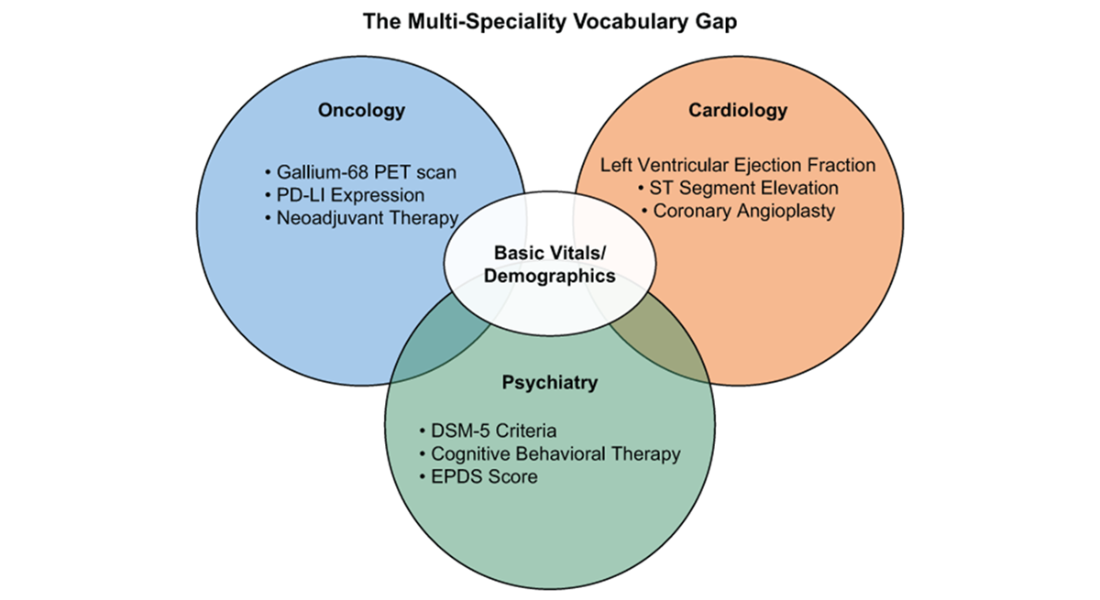
Use the vocabulary-gap figure to see why no single universal clinical ontology can represent every specialty and clinical context. section 3.2