Patient-specific information consists of measurements and observations intended to represent aspects of a person's health or healthcare. It is longitudinal and multimodal, spanning structured values, narratives, images, codes, records, and genomic data. Because it represents a human life, imprecision can become a clinical risk rather than merely a data-quality defect. section 1.0 section 1.5
Reliable patient-specific information requires developers to account for:
- Precision: correct identity, meaning, timing, terminology, and provenance make information usable at the point of care. section 1.2 section 1.2.1
- Trust: privacy, security, governance, and regulatory safeguards protect information while it moves through clinical and administrative workflows. section 1.2.2 section 1.5
- Interoperability: information must cross fragmented laboratories, clinics, hospitals, pharmacies, payers, and legacy formats instead of remaining in isolated systems. section 1.0 section 1.5
Clinical consequences of imprecision
An undocumented allergy in one system can produce an incorrect prescription in another. A CT scan without a unique identifier can trigger an unnecessary repeat scan, while a consent directive without provenance can delay treatment. section 1.2.1
Figure 1.2 “Precision“(technical correctness) and “trust“ (regulatory/operational safeguards) are the pillars of safe, effective care.
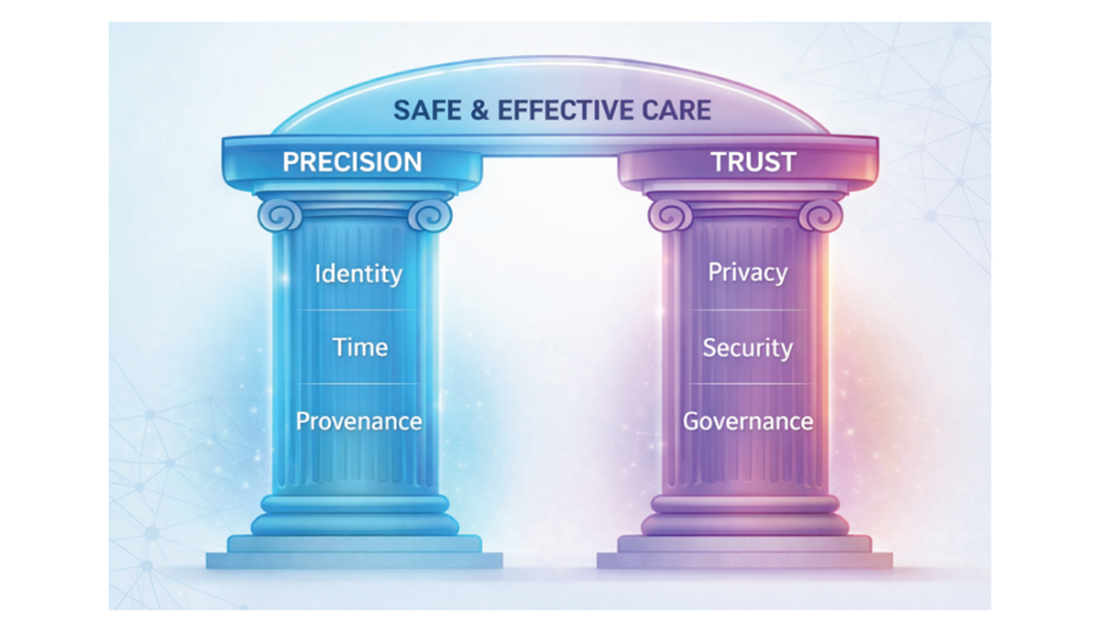
Use the precision-and-trust model to evaluate whether patient-specific information is both technically usable and appropriately protected. section 1.2