An identity platform manages the digital relationships an organization needs with people, organizations, devices, services, and agents. Its purpose is not merely to hold accounts or run logins: it lets systems recognize, remember, and relate to entities over time. section 2.8 section 2.1
To bridge the distance between an online system and its users, an identity platform creates accounts, authenticates requesters, and stores attributes for interaction context. Authentication determines whether a requester is who it claims to be; weak or spoofed identity signals can make otherwise sound access policies grant access to the wrong party. section 2.2.1 section 2.3.2
A useful platform supports digital relationships through:
- Integrity: consistently recognizing an entity across interactions so the relationship remains trustworthy. section 2.3.2
- Lifespan: managing account creation, use, and deletion across the relationship’s life cycle. section 2.3.2
- Utility: making appropriate identity information available to other systems, including for access control. section 2.3.2
Identity attributes, identifiers, relationships, issuing authority, and confidence levels become decision context for dynamic authorization. Different relationships—such as employee, customer, partner, device, service, or agent—can require distinct identity systems and different expectations for privacy, trust, and authority. section 2.8 section 2.3
Figure 1.1 Embedding access logic throughout application code (left) creates tight coupling. Externalizing authorization into a separate component (right) makes access policies explicit, decouples decision-making from application behavior, and enables scalable, auditable access control.
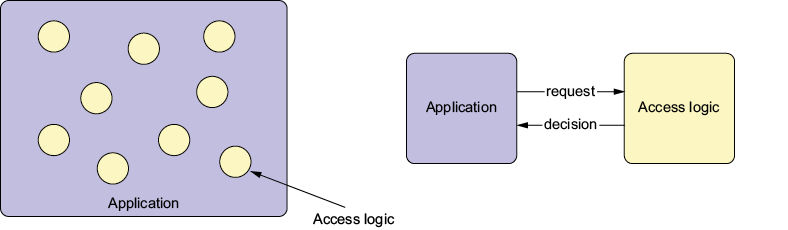
Externalizing authorization makes policy explicit and auditable, while identity supplies the reliable signals those policies need. section 1.1 section 1.6
