A policy information point (PIP) supplies the facts an authorization decision needs at runtime. When a policy decision point (PDP) evaluates a request, the PIP provides attributes and context about the principal, resource, and environment: identity, group membership, ownership, device posture, time, network risk, employment status, or account state. The policy enforcement point (PEP) intercepts the request and enforces the PDP’s resulting allow or deny decision. section 4.4 section 4.4.1
A report request outside approved hours
Alice requests a team report at 9:17 p.m. from a registered company laptop at home. The PDP asks the PIP for her group membership, device information, and permitted report hours. Alice is a Project Manager and uses a trusted device, but her normal report access ends at 8 p.m. The PDP can therefore return a deny decision with an explanation tied to the applicable policy, rather than relying on a role check embedded in the application. section 4.4.1
A PIP is an architectural role, not necessarily one service. In a production environment it commonly represents an integration layer over many sources: identity providers and directories, HR and finance systems, resource metadata, device posture clients, telemetry services, fraud systems, and external partners. The PDP sees a coherent set of attributes or relationships; behind it, the PIP ecosystem must retrieve, validate, and assemble those signals. section 12.1 section 6.1.2
Figure 12.1 Policy Information Points (PIPs): abstract vs. reality. Left: the abstract authorization architecture shows a single PIP feeding data to the Policy Decision Point (PDP). Right: in practice, the PIP represents many sources—including HR, Finance, authentication systems, device posture clients, external systems, and so on—all connected through APIs, tokens, and caches to deliver the trust signals that policies need.
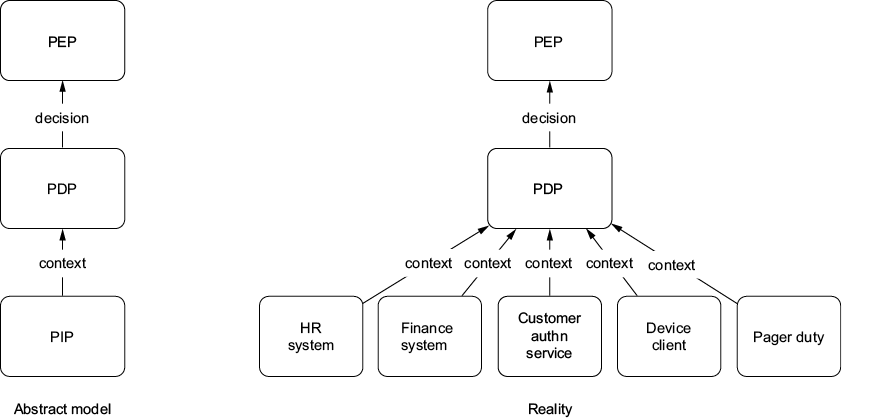
Compare the simple architectural PIP with the many APIs, tokens, caches, internal systems, and device signals that may implement it. section 12.1
PIP design centers on three linked decisions:
- Choose the signals a decision actually needs, such as employment status, multifactor authentication, device trust, geolocation, risk score, account balance, ownership, or relationship data. section 12.0
- Choose delivery: embed stable claims in tokens, fetch current facts through APIs, consume event streams, or combine these approaches. section 12.0 section 12.8
- Choose freshness: query live for high-risk actions, cache briefly when latency matters, or tolerate longer-lived claims where the risk permits it. section 12.7 section 4.5.3
Freshness and trust are authorization concerns, not merely integration details. Stale, inconsistent, or poorly governed attributes can produce the wrong result even when policy logic is correct. Attribute sources therefore need reliable synchronization and explanation; signal transmission benefits from provenance, signatures, and scoped sharing. An enterprise PIP can normalize disparate inputs into a shared schema so policies consume stable internal attributes instead of vendor-specific claims or credential formats. section 6.2.2 section 12.8 section 16.6.2
Deployment changes the operational tradeoff. Centralized PIPs and PDPs can support consistency and auditability, while distributed authorization clients can use locally refreshed entity caches to reduce latency and central runtime dependencies. Caching improves resilience and scale, but requires freshness controls, dependable policy synchronization, and consistent PDP behavior across deployments. section 4.5.3 section 4.7
The PIP role appears across authorization models. In an access control list (ACL) system it may only resolve the current user or group; in relationship-based access control (ReBAC), it can query a relationship graph alongside identity data; in attribute-based access control (ABAC), it supplies changing principal, resource, and environmental attributes. Separating this data-sourcing responsibility from policy evaluation keeps policies adaptable as systems and credential sources evolve. section 5.1.2 section 6.1.2 section 6.2.2
