Cloud Native Buildpacks package application source code and metadata into container images without requiring hand-written Dockerfiles. This source-to-image approach gives application developers a higher-level path to production-ready images than directly managing low-level image-building instructions. section 3.2.3 section 3.5
Buildpacks defines the specification, while implementations such as Paketo Buildpacks supply language- and framework-specific buildpacks. A builder image orchestrates a sequence of buildpacks covering concerns such as the operating system, certificates, language runtime, and SBOM generation; the builder itself is an OCI image shared through a registry. section 3.2.3
A practical adoption path includes:
- Use the Pack CLI to build an image directly from application source. section 3.5
- Use Spring Boot's built-in Buildpacks integration when working with a Spring Boot application. section 3.5
- Select community builder images or create organization-specific coverage when existing language and framework support is insufficient. section 3.2.3
- Consider alternatives such as ko when a source-to-image workflow should also support container build-and-deploy operations. section 3.5
Building and inspecting an application image
From an application directory, check the Pack CLI with `pack version`, build an image with `pack build appointments:0.0.1-SNAPSHOT`, or use `./gradlew bootBuildImage` for Spring Boot. Buildpacks also supports downloading image SBOMs with `pack sbom download`. section 3.2.3
Figure 3.6 The Source-to-Image pattern implemented with Cloud Native Buildpacks.
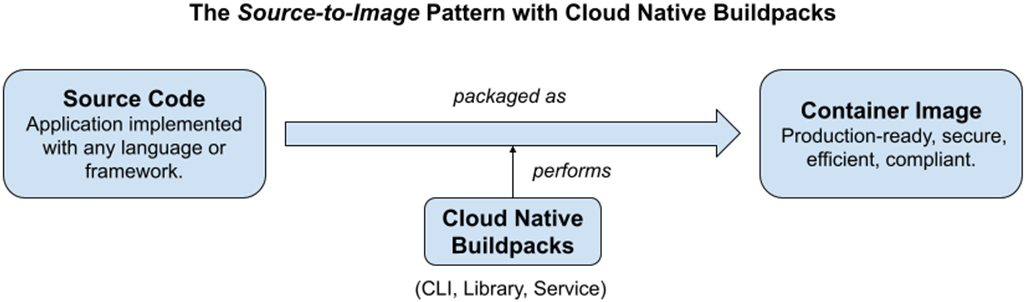
The source-to-image diagram shows how Buildpacks turns application source into a container image through its builder workflow. section 3.2.3


