A cloud WLC is a virtual machine deployed on a server in a private or public cloud. It provides a WLC option for lightweight AP deployments while retaining a split-MAC architecture. section 19.2.2 section 19.2.3
Evaluate a cloud WLC by its placement, capacity, and relationship to other wireless architectures:
- Place the WLC as a VM on cloud-hosted server resources; the cloud may be private and located in the company data center or publicly hosted. section 19.2.2
- Scale capacity with the VM’s available hardware resources: supported sizes can handle 1,000, 3,000, or up to 6,000 LWAPs and as many as 64,000 clients. section 19.2.2
- Keep the architecture distinct from cloud-based APs: a cloud WLC manages lightweight APs as a split-MAC system, whereas cloud-based APs connect to an SaaS management service. section 19.2.3
- Compare deployment scale with alternatives: unified WLCs use dedicated hardware, embedded WLCs integrate into switches, and Mobility Express integrates into APs. section 19.2.2
Capacity-based selection
A deployment requiring several thousand LWAPs can use a cloud WLC sized with sufficient VM resources; capacity can approach the 6,000-LWAP and 64,000-client scale of a unified WLC. section 19.2.2
Figure 19.9 WLC deployment options. A unified WLC is a dedicated hardware appliance. A cloud WLC is a VM deployed in a private or public cloud. An embedded WLC is integrated into a switch. A Mobility Express WLC is integrated into an AP.
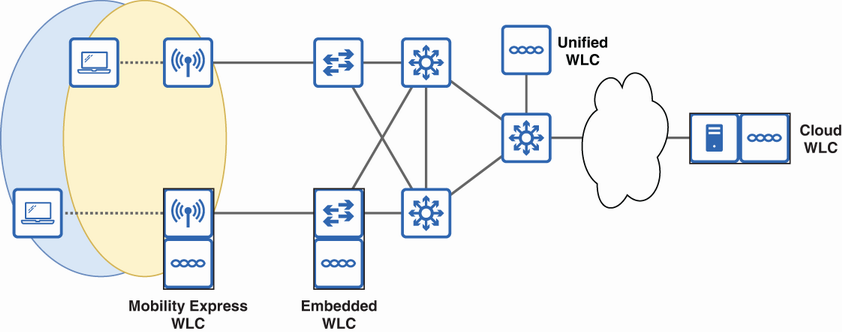
Compare cloud WLC placement with unified, embedded, and Mobility Express deployment models. section 19.2.2
