liveBook · Manning

Cluster testing

As explained in ScyllaDB in Action

Cluster testing is the evaluation of a database cluster against representative workloads to determine whether its resources and configuration meet operational requirements.

Cluster testing evaluates whether a database cluster can withstand production-level traffic and meet operational requirements. Treat the result as a baseline to tune rather than a perfect initial design. section 9.2.2

Use testing to guide multidimensional cluster decisions:

  • Send consequence-free, production-level traffic and observe whether the cluster withstands the workload. section 9.2.2
  • Account for disk space, CPU cores, memory, network bandwidth, and cost rather than optimizing one resource in isolation. section 9.2.2
  • For an estimated 1 TB of data with replication factor 3, allocate 6 TB across the cluster to allow for replication, uncompacted data, and growth. section 9.2.2
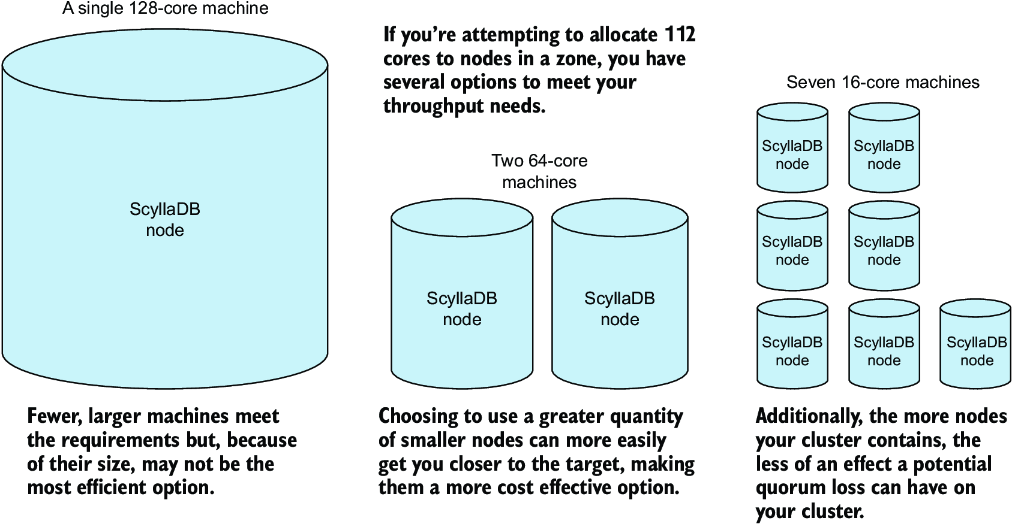
Figure 9.5 Using smaller nodes in your cluster can be a cost-effective way to meet your throughput goals, as well as increase your cluster’s availability if you were to lose a quorum.
figure

Compare smaller-node layouts when testing throughput goals and resilience after losing a quorum. section 9.2.2

How ScyllaDB in Action covers it

How deep it goes
Explains workload testing and disk-sizing principles, but stops short of providing a universal sizing formula.
Examples
Uses consequence-free production traffic and a 1 TB, replication-factor-three storage estimate requiring 6 TB of disk.
What it assumes
Assumes a chosen cluster topology and replication factor, while treating resource sizing as an empirical decision.
What you can do after
Evaluate a baseline cluster and tune its resources against representative production-level traffic.
How it connects
Connects cluster testing with cluster topology, replication factor, disk space, CPU, memory, network bandwidth, cost, and availability.

Related concepts

This explainer was generated by Manning's knowledge graph from the text of ScyllaDB in Action. The section links point to the parts of the book it draws on.