Colocation houses an organization’s servers and key network devices in rented space inside a third-party data center. The organization still purchases and operates its infrastructure, while the facility supplies space, power, cooling, and physical security. section 17.3
Colocation differs from nearby infrastructure models in these ways:
- Compared with on-premises infrastructure, it transfers facility requirements such as space, power, cooling, and physical security to the data center. section 17.3
- Compared with cloud computing, it leaves server ownership and operation with the business rather than providing on-demand shared computing resources. section 17.4
- Housing multiple customers in one facility can simplify connections between their networks and support efficient resource sharing. section 17.3
Figure 17.10 Two customers (Enterprise A and Enterprise B) house their servers in a colocation data center. They connect their networks in the data center, allowing them to share resources.
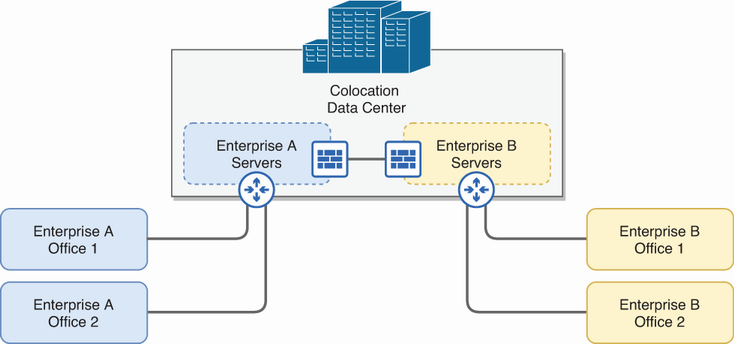
Use the topology figure to visualize two customers housing servers in one colocation data center and connecting their networks. section 17.3

