Memory coalescing combines the addresses requested by neighboring lanes in a warp into as few global-memory transactions as possible. Consecutive addresses use transactions efficiently; widely spaced addresses can fetch many bytes the lanes did not request. section 5.2.4
For a 32-lane warp loading FP32 values:
- With consecutive addresses, the 128 requested bytes occupy four 32-byte sectors, so four transactions serve the warp. section 5.2.4
- With a stride of 32 elements between lanes, the addresses fall in 32 separate sectors. The same 128 useful bytes require 32 transactions, using only 12.5% of the transferred bytes. section 5.2.4
A transpose store
In a naive matrix transpose, neighboring lanes can write to addresses separated by a row stride. For a large row-major output, each lane may touch a separate sector: 32 transactions for 128 useful bytes, rather than four for contiguous stores. Caching and architecture can affect traffic observed at DRAM, but the kernel still issues strided addresses. section 5.4.2
Figure 5.4 Memory transaction overhead. Four representative lanes are shown. For a complete FP32 warp, contiguous addresses occupy 4 adjacent 32-byte segments, while a sufficiently large stride can place the 32 requested values in 32 separate segments.
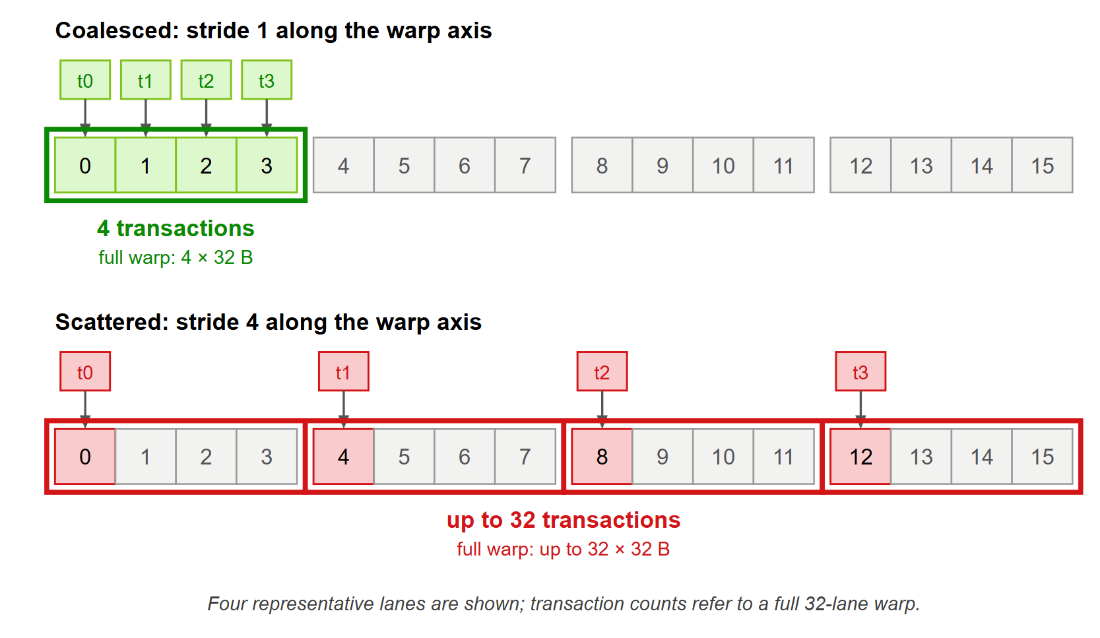
Compare how contiguous and widely spaced lane addresses occupy memory sectors. section 5.2.4
Correct indexing does not guarantee efficient data movement. Check the addresses requested together by a warp; in tiled transposes, reordering data on chip can help make global-memory accesses coalesced. section 5.10 section 5.4.2


