A coalition vector is a binary vector that records which features participate in a SHAP coalition. A 1 keeps a feature’s value from the example being explained; a 0 replaces it with a value from another randomly selected example. section 9.4.2
SHAP uses the vector to construct surrogate examples:
- Generate a random 0–1 vector z. section 9.4.2
- For every 1, retain the corresponding feature from the original example. section 9.4.2
- For every 0, substitute that feature from another randomly selected example, producing a realistic patchwork surrogate. section 9.4.2
Five-feature example
For x = [x1, x2, x3, x4, x5], z = [1,1,0,0,1] selects the first, second, and fifth features. The mapped surrogate is x′ = [x1, x2, x3rand, x4rand, x5]. section 9.4.2
Figure 9.18 SHAP creates a surrogate training set of examples in the locality of the example whose prediction needs to be explained.
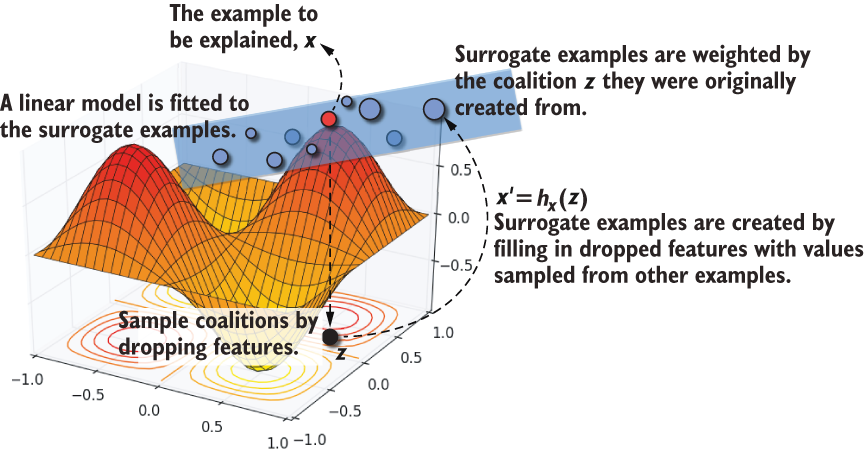
Shows how SHAP generates a surrogate training set near the example whose prediction is being explained. section 9.4.2
