Cognitive load is the complexity a team must understand and manage to do its work. It is not distributed evenly across a system: difficult business rules, scalability demands, aging technology, software cruft, and dependencies can all increase the burden. When that burden exceeds a team’s capacity, quality and pace may fall, context switching may obscure the team’s purpose, and unsustainable work can lead to burnout. Capacity also varies with team size and expertise. section 6.3.5 section 11.1.5
The Team Topologies model distinguishes three kinds of cognitive load:
- Intrinsic: difficulty inherent in the task, such as learning a new programming language rather than calculating a simple order total. Reducing it may require changing the task’s requirements. section 11.1.5
- Extraneous: avoidable difficulty introduced by the environment, such as legacy code that couples unrelated concepts. section 11.1.5
- Germane: effort spent learning a concept. section 11.6
Treat load as a constraint when assigning ownership. A subdomain too complex for one team can be split into smaller subdomains; several individually manageable subdomains can still overwhelm one team when their combined complexity and context-switching costs are counted. Map team boundaries onto a Core Domain Chart to spot teams owning multiple difficult areas, then use that picture to discuss boundaries and modernization priorities rather than assuming every area needs the same investment. section 11.1.5 section 6.3.5
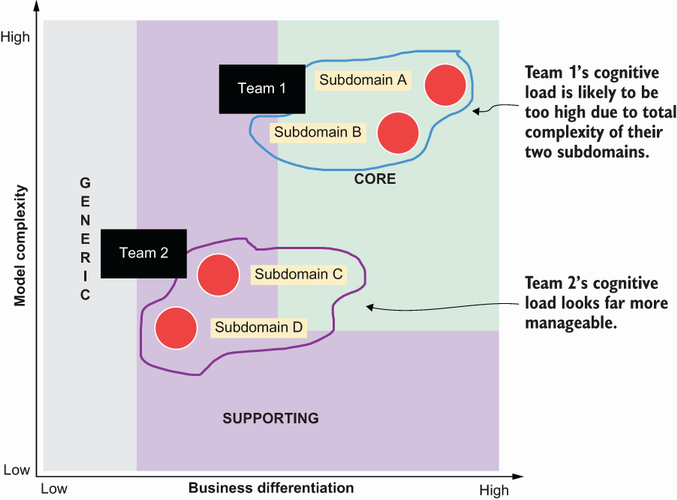
Use the Core Domain Chart to inspect where team boundaries may concentrate too much complexity in one team. section 11.1.5
When collaboration becomes the bottleneck
At a global cosmetics brand, an integration platform team collaborated with at least four other teams. It built and maintained custom endpoints because those teams lacked the skills or budget to do so. Mapping the interactions made the coordination cost visible: the platform team was overloaded and perceived as a bottleneck. The agreed direction was to stop accepting work outside the platform and hand over existing responsibilities—a change requiring sustained effort, not a quick redraw of the map. section 11.2.3
Reducing load for one group can move it elsewhere. A developer platform may simplify work for development teams while leaving platform engineers to manage numerous tools, compliance, and governance concerns. Seek their feedback and examine their workflows and pain points as the platform evolves. The same concern applies to users: research on a government service found that even one extra textbox, among unrelated questions, increased users’ cognitive load and anxiety. section 13.4.5 section 8.1





