Color theory combines principles about color relationships, perception, and visual effects to guide confident color choices in websites and applications. It helps developers move beyond generic templates and create more polished experiences for users. section 9.0 section 1.1.4
Use color theory as a practical decision-making toolkit:
- Reference the color wheel and color relationships when selecting a color scheme. section 9.0
- Create shades and tints to develop variations within a palette. section 9.0
- Account for emotional, personal, and cultural associations with color. section 9.0
- Check accessibility and remember that web color modes and screens can produce discrepancies. section 9.0
The checker-shadow illusion
In Adelson’s checker-shadow illusion, squares labeled A and B appear to have different brightness because of their surrounding context, although they are actually the same color when compared side by side. The example shows why color perception depends on more than a color value alone. section 9.0
Figure 9.1 Adelson’s checker-shadow is an optical illusion where squares A and B are the same color. (Source: Edward H. Adelson. Licensed under CC BY-SA 4.0)
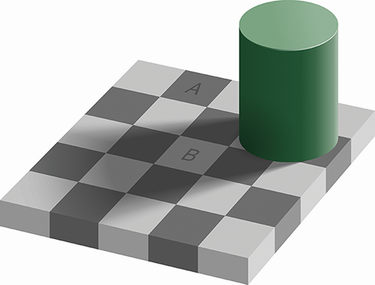
Use the figure to inspect how surrounding colors and shadow cues alter the perceived brightness of identical squares. section 9.0
