liveBook · Manning

Vector

As explained in AI Recommender Systems

An ordered collection of numerical components representing a point, direction, or quantity in a multidimensional space.

A vector is an ordered collection of numerical components. In recommendation systems, vectors represent items, users, or their preferences; dense embedding vectors compress information while preserving meaningful similarity. section 3.1.1 section 3.3.1

Figure 3.2 The movie matrix can have different types of representations; here, a TFIDF and an embedding representation.
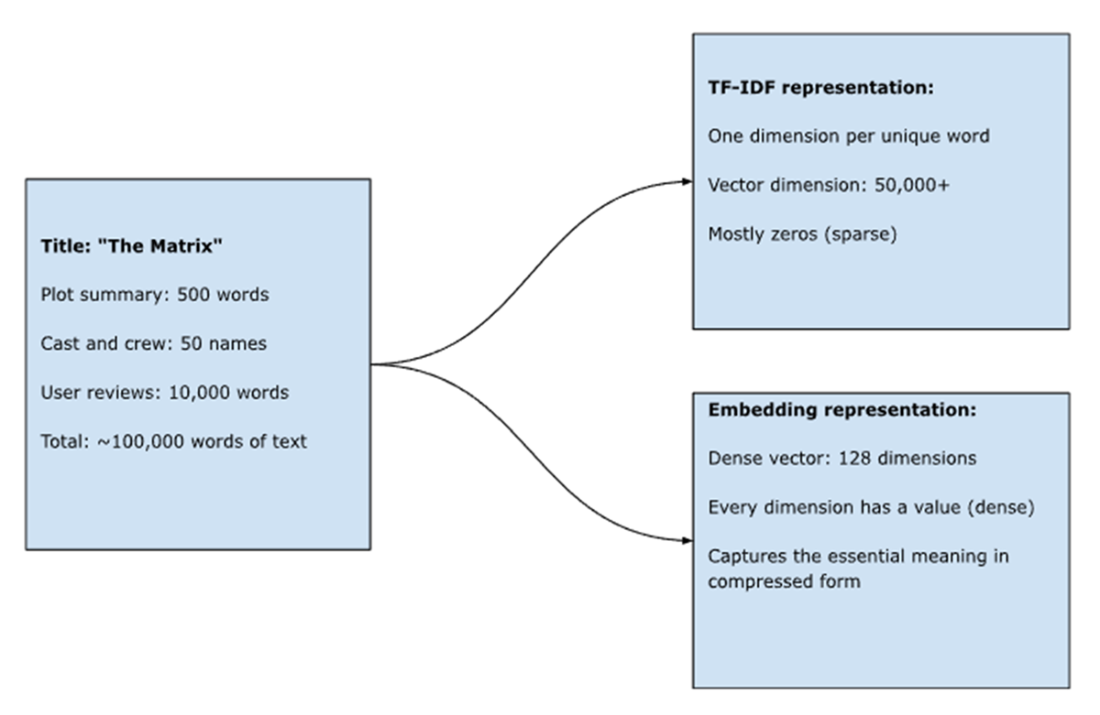
Compare a sparse TF-IDF representation with a dense embedding of the same movie information. section 3.1.1

Vector closeness can represent similarity. Cosine similarity compares direction; the dot product reflects direction and magnitude. For unit-length vectors, the two measures are equivalent. section 3.1.2 section 3.4.2

Estimating a movie rating

Matrix factorization represents a user and a movie as vectors in a shared latent space. Their dot product estimates the rating; Peter’s vectors produce 0.90 for Pulp Fiction and −0.18 for Toy Story. section 3.3.1


How AI Recommender Systems covers it

How deep it goes
Defines dense representations and explains similarity measures, embedding generation, and latent-factor rating estimates.
Examples
Uses movie-description embeddings and Peter’s user and movie vectors to illustrate representation and rating prediction.
What you can do after
Apply cosine similarity or dot products to compare embeddings or estimate user-item ratings.
How it connects
Connects vectors to embeddings, cosine similarity, dot products, matrix factorization, and collaborative filtering.

Also explained in

Compare how 3 books explain vector →

Related concepts

This explainer was generated by Manning's knowledge graph from the text of AI Recommender Systems. The section links point to the parts of the book it draws on.
