Common Information Model
The Common Information Model is a standardized object-oriented information model for representing managed computing resources and their relationships.
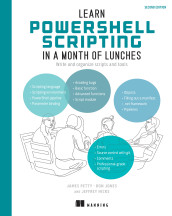
Learn PowerShell Scripting in a Month of Lunches, Second Edition: Write and organize scripts and tools
The Common Information Model is an industry standard object-oriented model for representing and managing information about systems and resources.
- How it is used
- Uses CIM to discover system information and perform service-management tasks in PowerShell automation.
- How deep it goes
- Develops command discovery and prerequisite checks, but stops short of explaining CIM internals or the complete automation tool.
- Examples
- Uses computer inventory queries, Get-CimInstance win32_service, BITS, and Print Spooler as practical examples.
- What you can do after
- Operate CIM through PowerShell to query local services and begin discovering classes for service changes.

Learn PowerShell in a Month of Lunches: Fourth Edition, Covers Windows, Linux, and macOS
CIM, the Common Information Model, is a standard information model for representing managed computing resources and their relationships.
- How it is used
- Applies CIM classes and methods to perform Windows administration when no dedicated PowerShell cmdlet exists.
- How deep it goes
- Demonstrates querying, filtering, method discovery, invocation, and return-value interpretation without detailing CIM internals.
- Examples
- Uses Intel network adapter configurations, filtered queries, EnableDHCP, and returned method-status values.
- What you can do after
- Operate/configure selected network adapters by filtering CIM instances and invoking their available methods.
Related concepts
- Windows Management Instrumentationalternative to · Windows Management Instrumentation is a Windows management infrastructure and API for querying, monitoring, and administering system resources.
- PowerShellused by · PowerShell is Microsoft's cross-platform command shell and scripting language for administering computer systems and automating tasks.
- cmdletused by · A cmdlet is a specialized PowerShell command, typically implemented as a .NET class, that performs a focused operation.
- CIM classhas part · A CIM class is a Common Information Model schema definition describing a category of managed resources through properties, relationships, and operations.
These guides are generated from the text of Manning books by Manning's knowledge graph and link to the sections they draw on. The full books are available on liveBook and at manning.com.